


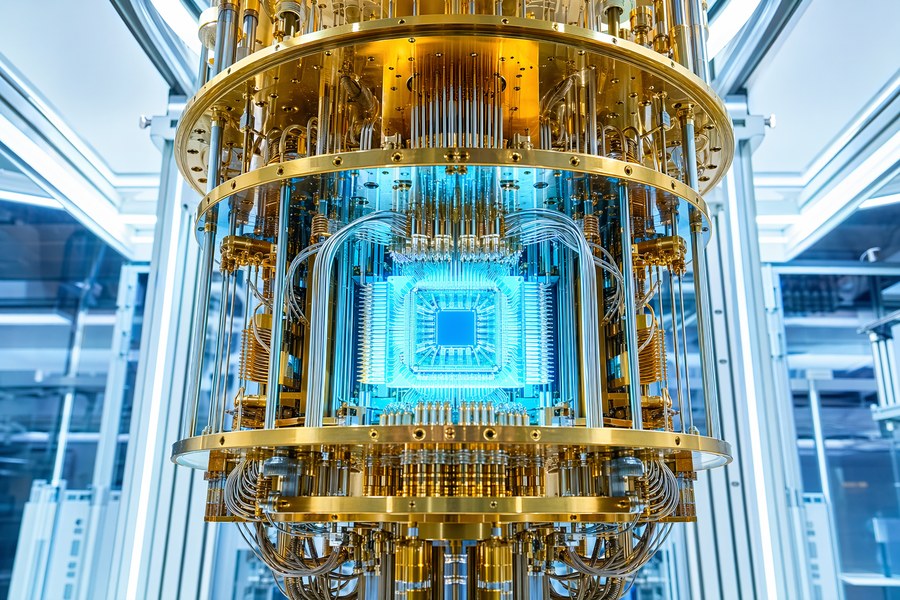
Right now, the way we keep our information safe on the internet uses special math puzzles that are hard for regular computers to solve. But new kinds of super-powerful computers called quantum computers can solve these puzzles much faster, which could make our secrets easier to crack. So, scientists are working on new ways to protect our information that even quantum computers can't break.
Read full article →Quantum eMotion made a new tool called eShield-Q to help keep computer secrets safe. It protects important information from being stolen or hacked, which is very important as more things happen online. This helps people and companies stay safe in the digital world.
Read full article →Imagine a dance where some dancers are not allowed to hold hands because of special dance rules. In some crystals, tiny parts called atoms also "dance" by vibrating, and certain vibrations aren’t supposed to mix or talk because of these rules called symmetry. But scientists found a new, strange kind of dance where these rules change, letting the vibrations mix in ways we didn’t think were possible, which could help us understand and make new materials better.
Read full article →Scientists found a way to make tiny waves inside magnets last 100 times longer. These waves, called magnons, can help build super small computers that work in a new and powerful way called quantum computing. This is exciting because it could make future computers much smaller and faster!
Read full article →Quantum technology uses tiny particles that can do many things at once to help solve big problems faster. Scientists are still learning how to use it better, and soon it might help make computers and machines much smarter in many jobs. It’s like having a super-powered brain that can work on really hard puzzles quickly.
Read full article →Scientists at Oxford found a new way to control tiny particles called ions, making them act in special ways like being "squeezed" four times over. This is important because it helps us understand and use super small particles better for future technology, like super-fast computers. It's like discovering a new trick to play with building blocks that can help us build cooler things!
Read full article →Scientists have found a way to see something like "time going backward" in their experiments. This is surprising because we usually think time only moves forward, like a clock ticking. Understanding this could help us learn new things about how the tiniest parts of the universe work!
Read full article →Scientists found a way to send tiny particles of light, called photons, through regular fiber cables without losing their special secret powers. This is like sending a super-secret message that no one can copy or peek at. It helps keep information very safe using our current internet wires!
Read full article →Scientists study how tiny things like atoms and particles change without losing or gaining heat. They found that even when there are sudden jolts or changes, these tiny things can still behave smoothly, like riding a bike over small bumps without falling. This helps us understand how to control super tiny machines better in the future.
Read full article →Scientists found a new way to build tiny computer parts called qubits, which are like super-smart switches for special computers. They put tiny electrons on frozen neon, and this helps the qubits stay calm and work better without much "noise"—which is like distractions that make computers make mistakes. This is important because it could help make faster and smarter computers in the future!
Read full article →Scientists used a few tiny tin atoms to find a special kind of superpower called superconductivity, where electricity flows without any resistance. It's like discovering a new secret way to make electricity travel super fast and easy. This helps us build amazing new materials for future technology!
Read full article →Scientists found a way to control tiny parts of hydrogen by freezing it in dry ice, which is super cold. This is important because it can help us store energy better, make faster computers, and learn about space in new ways. It’s like using ice to pause and control something really small and powerful!
Read full article →Scientists found that there is a fastest speed at which special tiny information, called quantum information, can spread. This speed depends on how "mixed up" and warm the system is, kind of like how heat moves faster in some things than others. Knowing this helps us understand how information moves in super small and strange places, which can be important for future technology.
Read full article →Scientists found a new way to change how light moves without using any mirrors or lenses. This is like twisting a flashlight beam just by waving your hand in the air. It could help doctors test patients faster and make internet connections work better in the future.
Read full article →Scientists made a special machine that works in super cold places and can create tiny sound particles called phonons. These phonons are like tiny waves of sound that could help make new kinds of lasers. This is important because these sound lasers might help us talk better or find problems inside our bodies.
Read full article →Scientists used tiny beams of special light called X-rays to see how light bends when it passes through super small gaps, much smaller than a hair. This helps us understand how light and tiny particles interact, which is important for new technologies like better screens and faster internet. It’s like discovering a secret trick that light uses to travel and change!
Read full article →Scientists found a way to fix a problem that was stopping tiny vibrations, called phonons, from being controlled in special quantum machines. This is important because it helps make better devices that can store and send information in new, powerful ways. It’s like finding a way to turn on a light that was always stuck in the dark!
Read full article →Scientists found a new way to use both regular and quantum computers together to better study tiny particles called electrons. This helps them understand how electrons work when they stick close and affect each other a lot. Learning this can help make new materials and technology in the future!
Read full article →Scientists have made a new way to send secret messages using tiny particles of light that are connected in a special way called "entanglement." This helps keep information super safe, like having a secret code that only you and your friend can understand. It’s important because it can help protect our messages from being hacked in the future.
Read full article →Scientists are making tiny parts called qubits that help computers think in a new, super-fast way. They found a clever way to build these parts using a special “window” and a strong frame, like putting a picture in a sturdy frame to keep it safe. This helps make better quantum computers that could solve big problems faster than regular computers.
Read full article →Scientists have found a better way to fix mistakes in special kinds of super-smart computers called quantum computers. This helps the computers work faster and more accurately, just like how checking your homework carefully can help you get better grades. This is important because it brings us closer to using quantum computers to solve big problems in the future.
Read full article →Scientists are working on special computer codes that help fix mistakes in tiny, super-powerful computers called quantum computers. They found a new way to arrange these codes inside layers of special materials that can carry electricity without losing energy. This helps make quantum computers work better and faster, which could one day solve really hard problems.
Read full article →Quantum computers can help us understand tiny particles called fermions, which are like the building blocks of everything around us. But these computers sometimes make mistakes, like a game with glitches. Scientists found a new way to fix these mistakes so the computer can give better answers faster.
Read full article →Quantum computers use tiny parts called qubits to solve problems much faster than regular computers. Scientists are working on special ways to keep qubits safe from mistakes, like building a strong fence around a playground. This helps make quantum computers more reliable and powerful in the future.
Read full article →Quantum computers use tiny particles to solve problems faster than regular computers. This new idea helps many small quantum computers work together like a team to solve tricky puzzles. It’s important because it can make quantum computers even better and help us learn new things faster.
Read full article →Michaela Eichinger works with quantum computers, which are super-powerful machines that can solve tricky problems faster than regular computers. She talks about how people need to work together and share ideas to make these machines better and help them grow. This is important because quantum computers can help us learn new things and solve big challenges in the future.
Read full article →Quantum eMotion made a new tool called eShield-Q to keep secret codes safe while computers are working. This is important because bad people and new powerful computers might try to steal these secrets. Think of it like a special shield that protects your treasure while you’re using it.
Read full article →Maryland is putting a lot of money into special computers called quantum computers, which can solve big problems much faster than regular ones. This helps the state create new jobs and become a leader in this cool technology. It’s like building a super-fast brain to help people do amazing things in the future!
Read full article →TreQ has made a special new computer called a quantum testbed in Oxfordshire, UK. This computer can try out different parts from many companies, like building with LEGO blocks that fit together easily. It helps scientists learn and create better quantum computers, which could solve big problems faster than regular computers.
Read full article →Some smart people made a special computer called a quantum computer work faster by using clever software. This software helps set up and check 21 tiny parts called qubits, which are like super tiny switches that can do lots of things at once. Making these computers ready quicker is important because it helps scientists solve really hard problems faster in the future!
Read full article →Some smart people made a tiny special computer called a quantum computer work by itself without much help. This computer uses tiny spots called nitrogen-vacancy centers, which are like little helpers inside diamonds, to do tricky math faster. Making it start up on its own is important because it helps scientists use these cool computers more easily in the future.
Read full article →Scientists used a special kind of computer called a quantum computer to watch how tiny particles called spins move in a line. This is important because it helps us understand how things like electricity work in very small spaces. It’s like using a super-smart robot to explore how a tiny train of magnets travels along a track!
Read full article →IBM and Dallara are working together to use super-smart computers to help design faster race cars. They use special computer programs that can learn and solve tricky problems, like how air moves around a car. This helps make racing cars better and faster, which is exciting for people who love speed and technology!
Read full article →A company called QuantumDiamonds has set up a special new machine in Taiwan that can help find tiny problems in computer parts. This machine uses a special kind of science called quantum sensing, which helps it see things much more clearly than normal tools. This is important because it can help make computers work better and faster in the future.
Read full article →A group called the Chicago Quantum Exchange made a plan to help train lots of people for new jobs with quantum computers, which are super-powerful computers of the future. This is important because many new jobs will open up, and they want to make sure people in the Midwest are ready to take them. It’s like getting a team ready to play a big game so everyone can win!
Read full article →Imagine you have a bunch of tiny spinning tops that can be lined up in different ways. Scientists found that depending on how you look at these spins, they lose their special “quantum memory” at different speeds. This is important because understanding how and why this happens helps us build better quantum computers that can remember information longer.
Read full article →Scientists studied a special kind of system where energy can be gained or lost, and things don’t behave the same going one way or the other. They found surprising ways that certain waves or signals stick to the edges or spread out in the system, kind of like how water might flow differently on a tilted or bumpy surface. This helps us understand new kinds of materials and could lead to better technology in the future!
Read full article →Scientists are finding new ways to test how gravity might connect tiny particles in a special way called entanglement, which is like a secret link between them. They discovered that even when particles aren’t falling freely but are moving in a controlled way, gravity can still create this link. This is important because it makes it easier to do experiments that help us understand how gravity works with the tiny building blocks of the universe.
Read full article →Quantum computers work in a very different way from regular computers. This new idea helps scientists understand how certain ways of getting information in quantum computers don’t fit together like pieces of a normal puzzle. Knowing this helps us learn more about how quantum computers can do special things that regular computers can’t.
Read full article →Quantum computers use special steps called gates to change tiny particles in a controlled way. This work shows that certain easy-to-make gates can create any possible state, even when there are rules like keeping the same number of particles. This is important because it helps scientists use quantum computers to study hard problems in physics and chemistry more easily.
Read full article →Imagine you have three friends sitting far apart, and they each get a secret message from different places. Even though they don't talk to each other, the messages are connected in a special way that only quantum physics can explain. This discovery helps us understand how tiny particles can share information in surprising ways, which could make future computers and communication much faster and safer.
Read full article →Scientists are studying tiny circuits that can hold and control particles of light, called photons, which can work together in new ways. This helps them learn how to make super-fast computers that use special bits called qubits, which can do many things at once. Understanding these special light and qubit interactions could help build better quantum computers in the future!
Read full article →Scientists made a new kind of computer helper that fixes mistakes in quantum computers faster and using less energy. This helper works like a smart messenger that quickly finds and corrects errors so the quantum computer can work better. This is important because it helps make super-powerful quantum computers more reliable and easier to build in the future.
Read full article →Imagine shining light through two tiny openings to make a pattern of bright and dark spots, like shadows. Scientists found that if you play this light pattern backward in time, it doesn’t just rewind—it changes how information about the light’s source is shared with the detector. This helps us understand light and information better, which could be important for future technology that uses light in smart ways.
Read full article →Quantum indeterminacy means we can’t know everything about tiny particles at the same time, like where they are and how fast they’re moving. This new idea shows that this mystery comes from the shape and rules of a special space where these particles live, not just from guessing or measuring. It helps us understand that the universe has built-in limits on what we can know, which is important for making super-powerful computers called quantum computers.
Read full article →Scientists found a new way to use both regular computers and tiny quantum computers together to help sort busy roads into smart zones. This is important because it helps traffic flow better and makes traveling easier. Think of it like using a team where each player does the job they are best at to solve a big puzzle faster.
Read full article →Scientists made a new, affordable tool that helps control tiny electric parts called ion traps. These ion traps are important for building super-powerful computers called quantum computers. This tool works quietly and can be used in many experiments, making it easier and cheaper to build these special computers.
Read full article →Scientists have found a way to use super-powerful computers and tiny quantum machines to study really big molecules, like parts of proteins, more accurately than before. This helps us understand how molecules work together, which is important for things like making new medicines. It’s like using a super detailed map to explore a huge city instead of just looking at a small neighborhood!
Read full article →Scientists have made a new way to help quantum computers fix their mistakes faster. This is like having a smart helper who only checks the parts that need fixing instead of looking at everything all the time. This helps quantum computers work better and makes them more reliable for solving big problems.
Read full article →Scientists are using special new computers called quantum computers to solve tricky problems where there’s a lot of guessing and chance, like figuring out the best way to pick things when the weights can change. This is important because it helps insurance companies make smarter choices even when things are uncertain. Quantum computers can work together with regular computers to find better answers faster than before!
Read full article →A virus called hantavirus made some people on a cruise ship very sick. Scientists are trying to figure out how the virus spread because it’s new and tricky. This is important so they can help the people on the ship and stop the virus from spreading to others.
Read full article →Scientists think they might have found a lost Maya city called Sac Balam. The way the buildings and land look is just like old stories say. Finding this city helps us learn more about how people lived a long time ago.
Read full article →A big whale named Timmy got stuck on the beach in Germany six weeks ago. Scientists were very worried because he was very sick and might have died. This is important because it helps people learn how to help whales in trouble.
Read full article →Gravity is the force that pulls things together, like when you drop a ball, it falls to the ground. Scientists tested a rule about gravity called the "inverse square law" by looking at huge groups of galaxies very far away. They found that this rule works even across these giant distances, helping us understand how the universe holds itself together.
Read full article →Shirley Meng is a scientist who works on making better batteries to help the Earth stay clean. She moved to Singapore because the rules in the U.S. made it harder for her to do this important work. Her goal is to help stop pollution and protect the planet for everyone.
Read full article →Scientists used special tools to see deep underground by checking how rocks carry electricity. This helped them find pieces of an old continent that used to be part of the United States. Knowing this is important because it can help us find valuable minerals and keep power grids safe.
Read full article →Scientists made tiny tools that can watch the brain when it has sudden bursts called "spikes." These spikes confuse the brain cells that help us think. Knowing when a spike will happen, even just one second before, can help doctors take better care of people with epilepsy.
Read full article →Scientists used smart computer programs called AI to help make a tiny living thing, a bacterium, that is missing one building block it usually needs. This is like making a new recipe with different ingredients to create special proteins that could help doctors and invent new medicines. It matters because it might help us make better medicines and tools to keep people healthy.
Read full article →A smart computer program can now help doctors figure out what’s wrong with sick patients, even when things are very busy and fast, like in an emergency room. This is important because it can help doctors make better and quicker choices to take care of people. It’s like having a very fast and smart helper who knows a lot about medicine.
Read full article →Deepfakes are fake pictures and videos that look real, made by computers. Hany Farid is a scientist who creates special tools to find these fake images. Now, he is working hard to stop new computer tricks that make deepfakes even trickier to spot.
Read full article →arXiv:2604.25048v1 Announce Type: new Abstract: We analyze the dynamics of a quantum particle in a one-dimensional bistable potential within the framework of Bohm's quantum mechanics. We give arguments that evidence the fallacy of certain claims found in the literature dealing with the impossibilit
Read full article →arXiv:2604.25058v1 Announce Type: new Abstract: The performance of the Quantum Approximate Optimization Algorithm (QAOA) on noisy intermediate-scale quantum (NISQ) devices is strongly limited by sparse qubit connectivity. When interactions required by QAOA Hamiltonians are not aligned to the hardwa
Read full article →arXiv:2604.25094v1 Announce Type: new Abstract: Near-term FTQC system designs are constrained by limited error budgets and largely sequential execution of non-Clifford gates. As a result, reducing the number of the most-error prone instructions becomes critical for successful program execution. In
Read full article →arXiv:2604.25137v1 Announce Type: new Abstract: We solve the time-dependent Schr\"odinger equation by learning the score function, the gradient of the log-probability density, on Bohmian trajectories. In Bohm's formulation of quantum mechanics, particles follow deterministic paths under the classic
Read full article →arXiv:2604.25140v1 Announce Type: new Abstract: We propose a parallel protocol for implementing distributed nonlocal quantum gates between spatially separated stationary qubits encoded in dual-species quantum emitters (i.e., color-center and superconducting qubits). By utilizing entangled photon pa
Read full article →arXiv:2604.25141v1 Announce Type: new Abstract: We present an alternative scheme to achieve nonreciprocal unconventional magnon blockade (NUMB) in a hybrid system formed by two microwave cavities and one yttrium iron garnet (YIG) sphere, where the pump and signal cavities interact nonlinearly with
Read full article →arXiv:2604.25148v1 Announce Type: new Abstract: In an extension of the Unconventional Noiseless Intermediate Quantum Emulator, this work introduces a classical emulation of the quantum Harrow-Hassidim-Lloyd algorithm for sampling from the solution space of linear systems. The emulated HHL algorithm
Read full article →arXiv:2604.25162v1 Announce Type: new Abstract: Demonstrating quantum advantage for combinatorial optimization requires more than standalone algorithmic results; it calls for end-to-end case studies that integrate problem modelling, quantum execution, and classical refinement into practical workflo
Read full article →arXiv:2604.25170v1 Announce Type: new Abstract: Among the many solid-state emitters being explored for scalable quantum technologies, the silicon T centre is a leading candidate offering long-lived spin qubits, a telecommunications-band spin-photon interface, and integration with on-chip photonic c
Read full article →arXiv:2604.25194v1 Announce Type: new Abstract: Network tomography refers to the use of inference techniques for inferring internal network states from end-to-end probes. Quantum probes, implemented by sending blocks of $n$ coherent-state pulses augmented with continuous-variable (CV) squeezing ($n
Read full article →arXiv:2604.25195v1 Announce Type: new Abstract: A minimal method to fabricate Al/AlO$_x$/Al Josephson junctions (JJs) using photolithography and argon etching, before metallization and oxidation, is demonstrated. JJs with areas ranging from 1 to 6 $\mu$m$^2$ can be fabricated and, with the appropri
Read full article →arXiv:2604.25225v1 Announce Type: new Abstract: Transmitter-device-dependence is a longstanding but often implicit problem in quantum key distribution (QKD), as compared to measurement-device-dependence. One-sided device-independent (1sDI) scenario relaxes the security conditions of DI framework an
Read full article →arXiv:2604.25229v1 Announce Type: new Abstract: We present the first quantum-hardware implementation of a Hamiltonian simulation algorithm that produces signed vector-field solutions to the time-domain Maxwells equations using a Schrodingerisation-based approach.The electromagnetic fields are discr
Read full article →arXiv:2604.25275v1 Announce Type: new Abstract: We study parameter transferability for the Quantum Approximate Optimization Algorithm (QAOA) across multiple combinatorial optimization problem classes from a parameter generation perspective. Specifically, a meta-optimizer is trained on one problem c
Read full article →arXiv:2604.25286v1 Announce Type: new Abstract: Discrete time crystals are non-equilibrium phases of matter in periodically driven systems, characterized by robust subharmonic oscillations and broken discrete time-translation symmetry. Their long-lived coherent dynamics and resilience to imperfecti
Read full article →arXiv:2604.25303v1 Announce Type: new Abstract: Scaling superconducting quantum processors is increasingly constrained by the wiring, heat load, and calibration overhead associated with delivering high-resolution analog signals from room temperature to qubits at millikelvin temperature. Here we dem
Read full article →arXiv:2604.25311v1 Announce Type: new Abstract: We investigate the role of continuous measurement and postselection in the dynamics and entanglement of a transmon-cavity-transmon coupled system. In the dispersive regime, characterized by a large detuning between the transmons and the cavity, the tw
Read full article →arXiv:2604.25333v1 Announce Type: new Abstract: We develop a systematic sign-embedding framework of operator-output quantum algorithms for matrix equations and matrix functions. Differing from the contour-integral treatment, we start with the matrix-sign embedding route: an augmented matrix $M$ who
Read full article →arXiv:2604.25424v1 Announce Type: new Abstract: We formulate a bounded distance decoding strategy applicable to all stabilizer codes including both CSS and non-CSS code-families. The framework emerges out of the local Clifford equivalence between arbitrary stabilizer states and graph states. Using
Read full article →arXiv:2604.25425v1 Announce Type: new Abstract: We clarified the physical mechanism of superconducting strip single photon detectors (SSPDs) with optical cavities by using transmission line and impedance models. By introducing the transmission line model, we derived the analytical formulae for the
Read full article →arXiv:2604.25433v1 Announce Type: new Abstract: Minor embedding is a required compilation step for quantum annealing, mapping logical problem graphs onto sparse hardware topologies. Despite its central role in determining solution quality, no standardized benchmark exists for comparing embedding al
Read full article →arXiv:2604.25480v1 Announce Type: new Abstract: Image classification is a core task of intelligent sensing, conventionally follows a sequential imaging then processing pipeline. However, redundant high-dimensional image reconstruction is inherently inefficient, especially in photon limited scenario
Read full article →arXiv:2604.25494v1 Announce Type: new Abstract: We study finite-size adiabatic state preparation on Boolean hypercubes using graph-local drivers built from sector/path coordinates related to monotone Gray-code representatives. The construction is not presented as a new all-$n$ Gray-code existence t
Read full article →arXiv:2604.25503v1 Announce Type: new Abstract: Bent Boolean functions extremal objects that maximally resist affine approximation are notoriously hard to construct for large numbers of variables. We propose a hybrid quantum-classical genetic algorithm (GA) that uses a \emph{quantum circuit}
Read full article →arXiv:2604.25509v1 Announce Type: new Abstract: Simon's algorithm is a polynomial period-finding algorithm that has been used to exploit the algebraic structure of specific symmetric ciphers, showing that exponential speedups in their cryptanalysis are theoretically possible. While the theoretical
Read full article →arXiv:2604.25524v1 Announce Type: new Abstract: Defect-adaptive surface-code methods have substantially advanced the construction of valid logical patches on imperfect hardware, but fault-tolerant computation also requires executable logical oper ations on the resulting irregular geometries. We for
Read full article →arXiv:2604.25531v1 Announce Type: new Abstract: This paper studies quantum optimization baselines for the Generalized Traveling Salesman Problem (GTSP), a clustered routing problem that naturally models variant selection and sequencing problems under discrete alternatives. We propose a novel GTSP Q
Read full article →arXiv:2604.25532v1 Announce Type: new Abstract: We identify a missing local-refinement stage in the cotengra tensor-network contraction pipeline and show that its impact grows monotonically with bond dimension on the \emph{connectivity graph} of Sycamore-like topologies. Appending a nearest-neighbo
Read full article →arXiv:2604.25573v1 Announce Type: new Abstract: We study algorithms inspired by quantum annealing that are suited for the NISQ era. First, we analyze approximate quantum annealing (AQA), which employs a discretized annealing ansatz in which the time step and the number of layers are allowed to devi
Read full article →arXiv:2604.25610v1 Announce Type: new Abstract: Artificial intelligent language-model based coding agents have significantly changed the way we interact with computers in our day-to-day, as it is common to use them to create, improve, and run programming scripts only using natural language. Agent c
Read full article →arXiv:2604.25613v1 Announce Type: new Abstract: In this paper, we resolve an open question in the field of optimization algorithms for training parametrized quantum circuits: Does the popular Rotosolve algorithm converge? Until now, interpolation-based coordinate descent methods such as Rotosolve h
Read full article →arXiv:2604.25615v1 Announce Type: new Abstract: Scalable optical quantum technologies require interference between large numbers of indistinguishable single-photons emitted by independent sources. Semiconductor quantum dots are known to be excellent on-demand sources of single-photons. They show re
Read full article →arXiv:2604.25620v1 Announce Type: new Abstract: The security of quantum key distribution (QKD) systems relies on the physical integrity of their components. While laser-damage attacks (LDAs) using high-power continuous-wave (cw) lasers have been well studied, the threat posed by pulsed lasers at al
Read full article →arXiv:2604.25631v1 Announce Type: new Abstract: A key bottleneck in quantum machine learning is the computational cost of repeated quantum circuit evaluations during the inference phase. To address this, we present a framework for constructing fast, cheap, provably accurate classical tensor-train s
Read full article →arXiv:2604.25640v1 Announce Type: new Abstract: We study a random unitary quantum circuit with only reset channels, which has high feasibility for real quantum devices. In particular, we investigate the many-body statistical physics properties, "reset-induced" entanglement phase transitions compari
Read full article →arXiv:2604.25644v1 Announce Type: new Abstract: Efficient quantum state preparation is a critical component in quantum algorithms that process large classical data, and it is fundamental to realizing quantum advantage in domains such as machine learning, quantum linear algebra, and quantum finance.
Read full article →arXiv:2604.25660v1 Announce Type: new Abstract: To meet the growing demand for nanoscale surface analysis, nitrogen-vacancy (NV) centers offer a high-sensitivity alternative by leveraging their ability to operate in immediate proximity to the sample. In this work, we propose a quantum control proto
Read full article →arXiv:2604.25663v1 Announce Type: new Abstract: Entropic uncertainty relations are universal quantifiers of fundamental uncertainties of quantum measurements and are widely discussed in the quantum metrology literature. Quantum memory is a phenomenon related to the specific type of quantum correlat
Read full article →arXiv:2604.25705v1 Announce Type: new Abstract: We propose a general method to fully characterize a classical stochastic noise process causing qubit dephasing through repetitive Ramsey interferometry measurements (RIMs) on the qubit. Compared to filter-function-based spectroscopy, our method does n
Read full article →arXiv:2604.25708v1 Announce Type: new Abstract: We compare four polynomial-resource measurement strategies, (I) $Z$-basis-only, (II) nearest-neighbor $ZZ$ (NN), (III) multi-basis ($Z$, $X$, $Y$), and (IV) classical shadows, for classifying three quantum circuit families: IQP, Clifford, and Clifford
Read full article →arXiv:2604.25715v1 Announce Type: new Abstract: We find the ground-state energy of the Ising model using the Cascaded Variational Quantum Eigensolver (CVQE) algorithm with the Guided-Sampling Ansatz (GSA) using up to 63 qubits on a quantum computer. We study a heavy-hex lattice to match the qubit a
Read full article →arXiv:2604.25747v1 Announce Type: new Abstract: We explore what the integrated use of quantum spatial distribution (QSD), or more specifically, superposition of both spin and position states of particles, and gauge symmetry (GS) within stabilizer formalism provides for quantum error correction. The
Read full article →arXiv:2604.25753v1 Announce Type: new Abstract: Two-dimensional spectroscopy (2DS) is a powerful ultrafast technique for probing electronic and vibrational dynamics in complex microscopic systems. Extracting detailed information on system dynamics and system-bath interactions from 2DS experiments r
Read full article →arXiv:2604.25755v1 Announce Type: new Abstract: SAR image classification naturally has to deal with huge noise and a high dynamic range particularly requiring robust classification models. Additionally, the deployment of these models on edge devices, such as drones and military aircraft, requires a
Read full article →arXiv:2604.25760v1 Announce Type: new Abstract: The Quantum Approximate Optimization Algorithm (QAOA) follows a single, fixed evolution path, overlooking the potential computational advantage of coherently superposing multiple trajectories. Here we overcome this limitation with a hybrid quantum wal
Read full article →arXiv:2604.25768v1 Announce Type: new Abstract: Quantum optimal control methods are widely used to design experimental control pulses such as laser amplitudes, phases, or detunings, that implement a target unitary evolution. In practice, what makes a pulse "good" depends not only on its fidelity, b
Read full article →arXiv:2604.25790v1 Announce Type: new Abstract: As emerging quantum architectures evolve into heterogeneous networks combining different physical substrates, such as qubits for logic and higher-dimensional qudits for robust communication, the traditional scalar metrics of quantum error correction b
Read full article →arXiv:2604.25801v1 Announce Type: new Abstract: The Nakajima-Zwanzig projected Liouvillian QLQ, the generator of the exact memory kernel in open quantum dynamics, is manifestly non-Hermitian yet has been reported to possess a purely real spectrum in the Jaynes-Cummings model -- an anomaly unexplain
Read full article →arXiv:2604.25807v1 Announce Type: new Abstract: Universally robust dynamical decoupling (UR$n$) sequences were proposed to compensate pulse imperfections arising from arbitrary experimental parameters while achieving high-order error suppression with only a linear increase in the number of pulses.
Read full article →arXiv:2604.25825v1 Announce Type: new Abstract: Partial differential equations (PDEs) are fundamental across numerous scientific fields. As these problems scale to high dimensions, classical numerical schemes introduce severe computational bottlenecks, known as the curse of dimensionality. Attempts
Read full article →arXiv:2604.25854v1 Announce Type: new Abstract: This paper investigates the interplay between the properties of quantum states on the Hilbert space \(\ell_2(\kappa)\) and the set-theoretic nature of the cardinal $\kappa$. We focus on the existence of singular $\sigma$-additive states~ -- function
Read full article →arXiv:2604.25861v1 Announce Type: new Abstract: The decomposition of complex quantum operations into experimentally feasible gate sets has been a central challenge since the early development of quantum computing. The multi-controlled Toffoli (MCT) gate is a key example, with applications across a
Read full article →arXiv:2604.25863v1 Announce Type: new Abstract: Distributed Quantum Computing (DQC) and Quantum Error Correction (QEC) rely on dynamic circuits that include Mid-Circuit Measurements (MCMs) and classical feedback. These operations present a major bottleneck: MCMs suffer from high error rates that le
Read full article →arXiv:2604.25864v1 Announce Type: new Abstract: There is widespread interest in many-body quantum systems that exhibit limit-cycle or time-crystalline behaviour. An ideal quantum limit cycle would be realized using fully coherent driving (to minimize noise) and also have a continuous internal symme
Read full article →arXiv:2604.25884v1 Announce Type: new Abstract: Quantum computing calibration depends on interpreting experimental data, and calibration plots provide the most universal human-readable representation for this task, yet no systematic evaluation exists of how well vision-language models (VLMs) interp
Read full article →arXiv:2604.25901v1 Announce Type: new Abstract: Continuous-variable quantum systems are promising candidates for quantum computing and quantum information processing. It is widely known that quadrature measurements on Gaussian continuous-variable systems can be described by a noncontextual hidden-v
Read full article →arXiv:2604.25910v1 Announce Type: new Abstract: Generation of highly non-classical quantum states of light is essential for optical quantum information processing and quantum metrology. Given the lack of sufficiently strong nonlinear interactions between optical fields, the commonly employed optica
Read full article →arXiv:2310.12634v1 Announce Type: cross Abstract: The KArlsruhe TRItium Neutrino experiment (KATRIN) aims to determine the effective mass of the electron antineutrino via a high-precision measurement of the tritium beta-decay spectrum in its end-point region. The target neutrino-mass sensitivity of
Read full article →arXiv:2604.24773v1 Announce Type: cross Abstract: Computational molecular design requires binding arrangements that are not only energetically favorable but also chemically realizable. However, computational methods remain limited in directly recovering fragment pose pairs that can later be connect
Read full article →arXiv:2604.24774v1 Announce Type: cross Abstract: We propose an orbital angular momentum (OAM) quantum holography scheme based on multi-mode Bessel-Gaussian (MBG) beams. Entangled photon pairs are generated through spontaneous parametric down-conversion (SPDC) process, and the axis prism parameters
Read full article →arXiv:2604.24803v1 Announce Type: cross Abstract: In low-depth implementations of the Quantum Approximate Optimization Algorithm (QAOA), the dominant cost is often the number of objective evaluations rather than circuit depth. We introduce a graph-conditioned trust-region method for reducing this q
Read full article →arXiv:2604.24829v1 Announce Type: cross Abstract: The Varenna school is a hub where generations of physicists, including numerous Nobel laureates, have shaped the field, often through collaborative exchanges across political and cultural boundaries. We examine the scientific legacy of Enrico Fermi
Read full article →arXiv:2604.24847v1 Announce Type: cross Abstract: We classify mobile Pauli stabilizer codes up to gapped interfaces and coarse-graining using the framework of algebraic $\mathrm{L}$-theory. We compare this classification with that of framed TQFTs, theories that arise naturally in the continuum, hig
Read full article →arXiv:2604.24871v1 Announce Type: cross Abstract: This article discusses incorrect statements appearing in textbooks on quantum field theory (QFT); some of these mistakes also appear in the research literature. The focus is not on errors made by an individual author, but on conceptual muddledness t
Read full article →arXiv:2604.24889v1 Announce Type: cross Abstract: Dual-species Rydberg atom arrays extend single-species platforms by introducing competing interaction scales and enhanced quantum fluctuations, enabling phenomena beyond homogeneous settings. In this work, we study the ground-state phase diagram of
Read full article →arXiv:2604.24896v1 Announce Type: cross Abstract: Quantum simulation offers a promising framework for quantum field theory calculations. Obtaining reliable results, however, requires careful characterization of systematic uncertainties. One important source is the boson truncation error, which aris
Read full article →arXiv:2604.24995v1 Announce Type: cross Abstract: This paper describes the design and implementation of a two-day quantum hackathon for underrepresented high school students in Nova Scotia, Canada. The first day of the hackathon is spent introducing students to quantum computing through hands-on ac
Read full article →arXiv:2604.25010v1 Announce Type: cross Abstract: Classical optical frameworks such as the discrete dipole approximation (DDA) assume that the linear spectrum of coupled quantum emitters can be computed solely from the linear susceptibilities of individual constituents. However, recent polariton st
Read full article →arXiv:2604.25097v1 Announce Type: cross Abstract: Electronic band structures and the Fermi energy provide essential information for understanding the electronic properties of solids. In semiconductors, the Fermi energy level is determined by the donor and acceptor concentrations. For diamond, the r
Read full article →arXiv:2604.25124v1 Announce Type: cross Abstract: To grow the quantum information science and technology workforce, opportunities for students to gain experiential learning and build a sense of belonging in the broader community are essential. The Undergraduate School on Experimental Quantum Inform
Read full article →arXiv:2604.25193v1 Announce Type: cross Abstract: Inverse design has made vast physical parameter spaces a substrate for emergent behavior. In sensing, the stakes of this principle are sharpest at the analog-to-digital boundary, where any information the hardware fails to capture is information no
Read full article →arXiv:2604.25248v1 Announce Type: cross Abstract: We investigate the non-equilibrium topology of a periodically driven, dissipative Su-Schrieffer-Heeger chain using the ensemble geometric phase (EGP) $\phi_{\mathrm{EGP}}$-a generalisation of the Zak phase to open quantum systems. In contrast to ear
Read full article →arXiv:2604.25429v1 Announce Type: cross Abstract: Lattice Boltzmann (LB) on quantum devices must reconcile unitary gate evolution with the dissipative \emph{collision} step. In the multiple-relaxation-time (MRT) class, we work in the common setting of \emph{modewise diagonal} moment relaxation, $\d
Read full article →arXiv:2604.25475v1 Announce Type: cross Abstract: A K-mirror rotates the wavefront of an incident optical field. However, the rotation always introduces polarization changes in the transmitted field. This is a serious concern for applications ranging from astronomical image derotation to orbital an
Read full article →arXiv:2604.25752v1 Announce Type: cross Abstract: Nuclear magnetic resonance (NMR) spectroscopy provides unparalleled access to molecular structure and dynamics but is traditionally limited by weak signal strength, requiring large sample volumes and high magnetic fields. Here, we demonstrate nanosc
Read full article →arXiv:2604.25808v1 Announce Type: cross Abstract: The theory of dynamical diffraction (DD) in perfect crystals is the backbone of high-precision neutron and X-ray diffraction experiments, enabling accurate determination of crystal structure factors and the realization of perfect crystal interferome
Read full article →arXiv:2604.25883v1 Announce Type: cross Abstract: Optical resonator-enhanced nonlinear interactions are of great importance for the efficient generation of continuous-wave second harmonic generation, optical parametric oscillation, frequency mixing, and the generation of squeezed light. In order to
Read full article →arXiv:2410.08937v3 Announce Type: replace Abstract: The trade-offs between error probabilities in quantum hypothesis testing are by now well-understood in the centralized setting, but much less is known for distributed settings. Here, we study a distributed binary hypothesis testing problem to infe
Read full article →arXiv:2411.14434v2 Announce Type: replace Abstract: This work introduces a quantum algorithm for computing the function arcsine, with arbitrary accuracy. We leverage a technique from embedded computing and Field-Programmable Gate Arrays, called COordinate Rotation DIgital Computer (CORDIC). CORDIC
Read full article →arXiv:2502.18812v4 Announce Type: replace Abstract: Quantum thermal states are known to be passive, as required by the second law of thermodynamics. This paper investigates the potential for work extraction by coupling a thermal bath to a qubit of either spin, fermionic, or topological type, which
Read full article →arXiv:2505.16444v2 Announce Type: replace Abstract: Quantum Simulation-based Optimization (QuSO) is a recently proposed class of optimization problems that entails industrially relevant problems characterized by cost functions or constraints that depend on summary statistic information about the si
Read full article →arXiv:2506.16949v4 Announce Type: replace Abstract: In classical physics, events follow a definite causal order: the past influences the future, but not the reverse. Quantum theory, however, permits superpositions of causal orders -- so-called indefinite causal orders -- which can provide operation
Read full article →arXiv:2506.19461v4 Announce Type: replace Abstract: Quantum machine learning models that leverage quantum circuits as quantum feature maps (QFMs) are recognized for their enhanced expressive power in learning tasks. Such models have demonstrated rigorous end-to-end quantum speedups for specific fam
Read full article →arXiv:2507.20101v3 Announce Type: replace Abstract: Very recently, Sharoglazova et al. performed an experiment measuring the energy-velocity relationship and Bohmian velocity in coupled waveguides. Their data show a discrepancy between the semi-classical `speed' $v=\sqrt{2|\Delta|/m}$ and Bohmian v
Read full article →arXiv:2508.02788v3 Announce Type: replace Abstract: Local measurements can radically reshape patterns of many-body entanglement, especially in long-range entangled quantum-critical states. Yet, analytical results addressing the effects of measurements on many-body states remain scarce, and measurem
Read full article →arXiv:2508.21288v2 Announce Type: replace Abstract: Weighted model counting (WMC) has proven effective at a range of tasks within computer science, physics, and beyond. However, existing approaches for using WMC in quantum physics only target specific problem instances, lacking a general framework
Read full article →arXiv:2509.01858v4 Announce Type: replace Abstract: We propose and analyze an all-mechanical route to coherent control and quantum-state reconstruction of the fundamental flexural mode of a suspended carbon nanotube (CNT) operated in the anharmonic (Duffing/Kerr). A nearby atomic force microscope (
Read full article →Insider Brief PRESS RELEASE — Fermi National Accelerator Laboratory (Fermilab) is strengthening the next generation of scientists and engineers through its Saturday Morning Quantum (SMQ*) program, graduating a new cohort of Chicago-area high school students prepared to explore career
Read full article →Insider Brief PRESS RELEASE — Infleqtion (NYSE: INFQ), a global leader in quantum computing and quantum sensing powered by neutral-atom technology, announced that the U.S. Navy has awarded the company a $1 million contract to advance its Quantum-Inspired Rapid Context (QuIRC) machine
Read full article →Insider Brief A series of announcements out of South Florida last week leave little doubt that the state’s quantum push has moved from positioning to delivery. The headline came on Friday at 2026 eMerge Americas Conference + Expo, when IonQ and Florida LambdaRail (FLR) signed a Master Service
Read full article →Insider Brief PRESS RELEASE — The Chicago Quantum Exchange released a new report today that outlines a regional strategy for expanding the quantum workforce, a crucial step in preparing for the tens of thousands of quantum jobs that are expected in the Illinois-Wisconsin-Indiana regi
Read full article →Scientists at the University of East Anglia have uncovered a hidden property of light that allows it to twist, spin and behave differently—without mirrors, materials or special lenses. In a breakthrough that could transform medical testing, data transmission and future quantum technologies, research
Read full article →npj Quantum Information, Published online: 28 April 2026; doi:10.1038/s41534-026-01249-4Scaffold-assisted window junctions for superconducting qubit fabrication
Read full article →Monarch Quantum and Oratomic have entered a strategic partnership to accelerate the development of utility-scale, fault-tolerant quantum computers. The collaboration integrates Monarch’s specialized photonics systems with Oratomic’s neutral atom computing architecture. Under the agreement, Monarch Q
Read full article →Haiqu, a New York-based quantum middleware developer, and HSBC have published peer-reviewed research in Physical Review Research demonstrating a method to overcome one of quantum computing's most significant hurdles: quantum state preparation. This process involves encoding classical data (such as f
Read full article →IBM has submitted a proposal to the Town of Poughkeepsie Planning Board to construct a new 511,000-square-foot quantum computing facility at its historic Poughkeepsie campus. The project involves the demolition of two existing buildings totaling 161,000 square feet to accommodate a manufacturing and
Read full article →David Morens could face prison time for allegedly concealing back-channel efforts to help nonprofit accused of starting pandemic
Read full article →Germany and Brazil reach agreement over controversial spinosaurid fossil, heralding new collaboration between the two nations
Read full article →Researchers at McGill University have developed a novel device that generates sound-like particles known as phonons at extremely cold temperatures. The technology could be used to create phonon lasers, with possible applications in communications and medical diagnostics.
Read full article →A rainbow reveals with colors what otherwise remains hidden: light is "refracted" by transparent matter, in this case water droplets. This same physical effect underlies many everyday technologies, like LCD screens and broadband connections based on fiber-optic cables. Light refraction is caused by
Read full article →IonQ (NYSE: IONQ) and Florida LambdaRail (FLR) have announced a Master Service Agreement to deploy a quantum-safe communication network across the state of Florida. Announced at the 2026 eMerge Americas Conference, the initiative marks the first phase of a broader effort to transition critical fiber
Read full article →Yuval Boger interviews Lionel Martellini, finance professor at the EDHEC and founding director of the EDHEC Quantum Institute. Lionel describes his unusual path from finance to astrophysics and why business schools should teach quantum awareness to future leaders. They discuss core quantum concepts,
Read full article →QuantX Labs has announced that a subsystem payload of TEMPO, its compact optical atomic clock, is now in orbit following a successful launch on March 30, 2026, via the SpaceX Transporter-16 mission. Developed in partnership with the Institute for Photonics and Advanced Sensing (IPAS) at Adelaide Uni
Read full article →Quantum Art, an Israeli-based developer of full-stack trapped-ion quantum computers, has extended its Series A financing to $140 million. Led by Bedford Ridge Capital, the extension follows an initial $100 million round announced in December 2025 and includes new participation from Hudson Bay Capita
Read full article →IQM Quantum Computers has reached an agreement with TOYO Corporation for the sale and deployment of an IQM Radiance 20-qubit system. This transaction marks the first instance of an enterprise-purchased quantum computer deployment in Japan. The full-stack superconducting system is scheduled for deliv
Read full article →Hawking’s signature prediction may prevent vexing singularities from forming
Read full article →Before antiretroviral drugs reached South Africa, high death toll shaped immune system genes
Read full article →Pennsylvania has launched the Keystone AI + Quantum Factory, a first-of-its-kind statewide innovation network designed to transition academic research into industrial applications. This historic collaboration aligns the Commonwealth's seven R1 research universities—Carnegie Mellon, Drexel, Lehigh, P
Read full article →Quantinuum LLC, a quantum hardware company majority owned by Honeywell, has filed a confidential S-1 form on February 17, 2026 with the U.S. Security and Exchange Commission (SEC) for a proposed Initial Public Offering (IPO) of Quantinuum’s common stock. This detailed registration statement will un
Read full article →Dismissal of the National Science Board is widely seen as latest move to erase NSF’s independence
Read full article →Three RIKEN researchers have demonstrated a way to stop problematic "dark modes" from squelching intriguing effects in quantum systems. This advance could help with the development of more versatile quantum devices that can be used to control the storage and transmission of quantum information. The
Read full article →A novel approach for realizing the one-way quantum synchronization of phonons has been proposed by three theoretical physicists at RIKEN. Importantly, this method is remarkably resilient against practical challenges such as imperfections and environmental noise. Their paper, "Nonreciprocal quantum s
Read full article →npj Quantum Information, Published online: 24 April 2026; doi:10.1038/s41534-026-01242-xEfficient post-selection for general quantum LDPC Codes
Read full article →npj Quantum Information, Published online: 24 April 2026; doi:10.1038/s41534-026-01243-wPlacing and routing quantum LDPC codes in multilayer superconducting hardware
Read full article →npj Quantum Information, Published online: 24 April 2026; doi:10.1038/s41534-026-01248-5Near-term fermionic simulation with subspace noise tailored quantum error mitigation
Read full article →Agency’s temporary director says Morbidity and Mortality Weekly Report needs external reviewers
Read full article →As SpaceX readies its latest megarocket, engineer Stephen Whitmore explains why atmospheric reentry pushes materials to their limits
Read full article →Experts say the lapse highlights that even new measures to control access did not safeguard deidentified patient information
Read full article →Flood of proposals to European Research Council—perhaps unleashed by AI—means unsuccessful applicants must wait longer to reapply
Read full article →The most demanding calculations in quantum chemistry can now be solved with graphics processing unit (GPU) supercomputers. A recently published study shows that software adapted to use GPU hardware can provide not just speed, but also the accuracy needed to solve complex chemistry problems. The work
Read full article →Semiconductor spin qubits are a promising candidate for the building blocks of next-generation quantum computers due to their high potential for integration and compatibility with existing semiconductor technologies. Qubits—like the 0s and 1s of a traditional computer—serve as a basic unit of inform
Read full article →Quantum computers, devices that process information leveraging quantum mechanical effects, could tackle some tasks that are difficult or impossible to solve using classical computers. These systems represent data as qubits, units of information that can exist in multiple states at once, unlike the b
Read full article →Researchers in the US and Germany have unveiled a theoretical blueprint for an atomic clock driven by a highly synchronized laser, where atoms work in concert rather than independently. Publishing their results in Physical Review Letters, Jarrod Reilly at the University of Colorado, Simon Jäger at t
Read full article →Long-awaited policy shift could ease barriers for scientists who study the drug
Read full article →It was a head-spinning discovery. In 2018, researchers in Japan claimed to find concrete evidence of an elusive particle, a Majorana fermion, in a quantum spin liquid called ruthenium trichloride. Majoranas are highly sought-after by quantum materials scientists because when a pair are localized, or
Read full article →A new method developed at LMU overcomes fundamental resolution limits and may provide insights into high-temperature superconductivity. Physicist Dr. Sebastian Paeckel has developed a method that can be used to calculate spectral functions of complex quantum systems much more precisely than was poss
Read full article →When you throw a ball in the air, the equations of classical physics will tell you exactly what path the ball will take as it falls, and when and where it will land. But if you were to squeeze that same ball down to the size of an atom or smaller, it would behave in ways beyond anything that classic
Read full article →A tiny discrepancy in particle physics has loomed for decades as an exciting possible crack in one of science's most successful theories, hinting at unknown forces or quantum objects. Now, an international team led by a Penn State physicist has published the most precise study yet to reveal the disc
Read full article →Only about 5% of the universe is composed of normal matter that we can directly observe, while the remaining 95% is widely believed to consist of dark matter and dark energy. Paradoxically, however, the nature of these dark components remains unknown. Is this due to limitations in our observational
Read full article →npj Quantum Information, Published online: 22 April 2026; doi:10.1038/s41534-026-01241-ySurface-code hardware Hamiltonian
Read full article →As long as there's been an internet, there's been a way to hack it. Scientists have spent decades imagining a different kind of network, one where the laws of physics make eavesdropping physically impossible, not just technically difficult. They call that dream a quantum internet.
Read full article →Researchers from the University of Twente and Harvard University have developed a new way to generate ultraviolet (UV) light on a photonic chip at power levels high enough for real-world use. For the first time, the technique produces milliwatt-level UV light on a chip. It is an important step for q
Read full article →Researchers have discovered a new way to tune the quantum properties of tiny defects in diamond—by gently stretching or compressing the crystal. These findings could pave the way for next-generation sensors that can detect pressure, temperature, and other physical changes with unprecedented precisio
Read full article →A quantum spin liquid is a phase of matter in which the magnetic moments in a material do not align or freeze, even at temperatures close to absolute zero (i.e., at 0 K). The experimental realization of this highly dynamic state could have important implications for the development of quantum comput
Read full article →npj Quantum Information, Published online: 21 April 2026; doi:10.1038/s41534-026-01247-6Distributed quantum inner product estimation with structured random circuits
Read full article →npj Quantum Information, Published online: 21 April 2026; doi:10.1038/s41534-026-01221-2Two-qubit gates using on-demand single-photons from ordered shape and size controlled large-volume superradiant quantum dots
Read full article →The cosmological constant is the mathematical description of the energy that drives the ever-accelerating expansion of the cosmos. It's also the source of one of the most enduring and confounding problems in modern physics.
Read full article →A new theoretical study finds shorter laser pulses achieve higher quantum efficiency for photoemission from a solid surface without increasing power or intensity. Using light to knock electrons loose from a surface—known as photoemission—may soon be achievable more easily in smaller labs with smalle
Read full article →A joint theoretical study by the University of Innsbruck and Zhejiang University has uncovered the microscopic origin of a striking quantum phenomenon: a periodically driven gas of ultracold atoms that simply refuses to heat up, defying classical expectations.
Read full article →Superconducting qubits—bits of quantum information—have been widely considered a promising technology for moving quantum computing forward. But there's still much work to be done before they can be brought out of a near absolute zero temperature environment. The lab of Professor Hong Tang has recent
Read full article →Few concepts in physics are as familiar, yet as enigmatic, as time. In Einstein's theory of relativity, time is not absolute: its passage depends on motion and gravity. But when combined with quantum physics, this relativistic form of time becomes even more counterintuitive.
Read full article →Two independent research teams have each demonstrated collisional quantum gates using fermionic atoms: a long-sought milestone in quantum computing where logic operations are performed through the direct physical overlap of atoms, rather than forcing them into fragile, highly excited states.
Read full article →In the quirky quantum world, particles can be affected by forces that they never directly encounter. A classic example is the Aharonov–Bohm (AB) effect, where electrons are affected by a magnetic field, despite not passing through it. Although predicted in 1959, it took more than two decades to conf
Read full article →Researchers in the UC Santa Barbara Materials Department have uncovered the elusive quantum mechanism by which energetic electrons break chemical bonds inside microelectronic devices—a detrimental process that slowly degrades performance over time. The discovery, published as an Editors' Suggestion
Read full article →A new study published in Nature Communications has shown that in the asymptotic limit, extracting the maximum possible work from many copies of a quantum system does not require knowing exactly what state that system is in.
Read full article →A joint research team led by Professor Park Kyoung-Duck and Associate Director Suh Yung Doug of the Center for Multidimensional Carbon Materials within the Institute for Basic Science (IBS) has succeeded in realizing a high-efficiency quantum light source that emits bright lights even at room temper
Read full article →An AI model informed by calculations from a quantum computer can better predict the behavior of a complex physical system over the long term than current best models that use only conventional computers, according to a new study led by UCL (University College London) researchers. The findings, publi
Read full article →A new Bar-Ilan University study points to a major advance in quantum information processing, demonstrating a way to send, manipulate, and measure quantum information across many frequency channels simultaneously, rather than one at a time. The study was recently published in the journal Science Adva
Read full article →eleQtron is a company making super-powerful computers called quantum computers, which can solve big problems much faster than regular ones. They just got a lot of money—€57 million—to help build bigger and better versions. This is important because these special computers could change how we do things like medicine, science, and technology in the future.
Read full article →Scientists used special super-powerful computers called quantum computers to create a detailed model of a very big protein made of over 12,000 atoms. This is like building a giant LEGO set in the computer to better understand how it works. Learning this helps doctors and scientists figure out how our bodies work and could lead to new medicines.
Read full article →Right now, the way we keep our information safe on the internet uses special math puzzles that are hard for regular computers to solve. But new kinds of super-powerful computers called quantum computers can solve these puzzles much faster, which could make our secrets easier to crack. So, scientists are working on new ways to protect our information that even quantum computers can't break.
Read full article →Quantum eMotion made a new tool called eShield-Q to help keep computer secrets safe. It protects important information from being stolen or hacked, which is very important as more things happen online. This helps people and companies stay safe in the digital world.
Read full article →Michaela Eichinger works with quantum computers, which are super-powerful machines that can solve tricky problems faster than regular computers. She talks about how people need to work together and share ideas to make these machines better and help them grow. This is important because quantum computers can help us learn new things and solve big challenges in the future.
Read full article →Quantum eMotion made a new tool called eShield-Q to keep secret codes safe while computers are working. This is important because bad people and new powerful computers might try to steal these secrets. Think of it like a special shield that protects your treasure while you’re using it.
Read full article →Maryland is putting a lot of money into special computers called quantum computers, which can solve big problems much faster than regular ones. This helps the state create new jobs and become a leader in this cool technology. It’s like building a super-fast brain to help people do amazing things in the future!
Read full article →TreQ has made a special new computer called a quantum testbed in Oxfordshire, UK. This computer can try out different parts from many companies, like building with LEGO blocks that fit together easily. It helps scientists learn and create better quantum computers, which could solve big problems faster than regular computers.
Read full article →Some smart people made a special computer called a quantum computer work faster by using clever software. This software helps set up and check 21 tiny parts called qubits, which are like super tiny switches that can do lots of things at once. Making these computers ready quicker is important because it helps scientists solve really hard problems faster in the future!
Read full article →Some smart people made a tiny special computer called a quantum computer work by itself without much help. This computer uses tiny spots called nitrogen-vacancy centers, which are like little helpers inside diamonds, to do tricky math faster. Making it start up on its own is important because it helps scientists use these cool computers more easily in the future.
Read full article →Scientists used a special kind of computer called a quantum computer to watch how tiny particles called spins move in a line. This is important because it helps us understand how things like electricity work in very small spaces. It’s like using a super-smart robot to explore how a tiny train of magnets travels along a track!
Read full article →IBM and Dallara are working together to use super-smart computers to help design faster race cars. They use special computer programs that can learn and solve tricky problems, like how air moves around a car. This helps make racing cars better and faster, which is exciting for people who love speed and technology!
Read full article →A company called QuantumDiamonds has set up a special new machine in Taiwan that can help find tiny problems in computer parts. This machine uses a special kind of science called quantum sensing, which helps it see things much more clearly than normal tools. This is important because it can help make computers work better and faster in the future.
Read full article →A group called the Chicago Quantum Exchange made a plan to help train lots of people for new jobs with quantum computers, which are super-powerful computers of the future. This is important because many new jobs will open up, and they want to make sure people in the Midwest are ready to take them. It’s like getting a team ready to play a big game so everyone can win!
Read full article →A virus called hantavirus made some people on a cruise ship very sick. Scientists are trying to figure out how the virus spread because it’s new and tricky. This is important so they can help the people on the ship and stop the virus from spreading to others.
Read full article →Scientists think they might have found a lost Maya city called Sac Balam. The way the buildings and land look is just like old stories say. Finding this city helps us learn more about how people lived a long time ago.
Read full article →A big whale named Timmy got stuck on the beach in Germany six weeks ago. Scientists were very worried because he was very sick and might have died. This is important because it helps people learn how to help whales in trouble.
Read full article →Gravity is the force that pulls things together, like when you drop a ball, it falls to the ground. Scientists tested a rule about gravity called the "inverse square law" by looking at huge groups of galaxies very far away. They found that this rule works even across these giant distances, helping us understand how the universe holds itself together.
Read full article →Shirley Meng is a scientist who works on making better batteries to help the Earth stay clean. She moved to Singapore because the rules in the U.S. made it harder for her to do this important work. Her goal is to help stop pollution and protect the planet for everyone.
Read full article →Scientists used special tools to see deep underground by checking how rocks carry electricity. This helped them find pieces of an old continent that used to be part of the United States. Knowing this is important because it can help us find valuable minerals and keep power grids safe.
Read full article →Scientists made tiny tools that can watch the brain when it has sudden bursts called "spikes." These spikes confuse the brain cells that help us think. Knowing when a spike will happen, even just one second before, can help doctors take better care of people with epilepsy.
Read full article →Scientists used smart computer programs called AI to help make a tiny living thing, a bacterium, that is missing one building block it usually needs. This is like making a new recipe with different ingredients to create special proteins that could help doctors and invent new medicines. It matters because it might help us make better medicines and tools to keep people healthy.
Read full article →A smart computer program can now help doctors figure out what’s wrong with sick patients, even when things are very busy and fast, like in an emergency room. This is important because it can help doctors make better and quicker choices to take care of people. It’s like having a very fast and smart helper who knows a lot about medicine.
Read full article →Deepfakes are fake pictures and videos that look real, made by computers. Hany Farid is a scientist who creates special tools to find these fake images. Now, he is working hard to stop new computer tricks that make deepfakes even trickier to spot.
Read full article →QuantX Labs has announced that a subsystem payload of TEMPO, its compact optical atomic clock, is now in orbit following a successful launch on March 30, 2026, via the SpaceX Transporter-16 mission. Developed in partnership with the Institute for Photonics and Advanced Sensing (IPAS) at Adelaide Uni
Read full article →Quantum Art, an Israeli-based developer of full-stack trapped-ion quantum computers, has extended its Series A financing to $140 million. Led by Bedford Ridge Capital, the extension follows an initial $100 million round announced in December 2025 and includes new participation from Hudson Bay Capita
Read full article →IQM Quantum Computers has reached an agreement with TOYO Corporation for the sale and deployment of an IQM Radiance 20-qubit system. This transaction marks the first instance of an enterprise-purchased quantum computer deployment in Japan. The full-stack superconducting system is scheduled for deliv
Read full article →Hawking’s signature prediction may prevent vexing singularities from forming
Read full article →Before antiretroviral drugs reached South Africa, high death toll shaped immune system genes
Read full article →Pennsylvania has launched the Keystone AI + Quantum Factory, a first-of-its-kind statewide innovation network designed to transition academic research into industrial applications. This historic collaboration aligns the Commonwealth's seven R1 research universities—Carnegie Mellon, Drexel, Lehigh, P
Read full article →Quantinuum LLC, a quantum hardware company majority owned by Honeywell, has filed a confidential S-1 form on February 17, 2026 with the U.S. Security and Exchange Commission (SEC) for a proposed Initial Public Offering (IPO) of Quantinuum’s common stock. This detailed registration statement will un
Read full article →Dismissal of the National Science Board is widely seen as latest move to erase NSF’s independence
Read full article →Three RIKEN researchers have demonstrated a way to stop problematic "dark modes" from squelching intriguing effects in quantum systems. This advance could help with the development of more versatile quantum devices that can be used to control the storage and transmission of quantum information. The
Read full article →A novel approach for realizing the one-way quantum synchronization of phonons has been proposed by three theoretical physicists at RIKEN. Importantly, this method is remarkably resilient against practical challenges such as imperfections and environmental noise. Their paper, "Nonreciprocal quantum s
Read full article →Agency’s temporary director says Morbidity and Mortality Weekly Report needs external reviewers
Read full article →As SpaceX readies its latest megarocket, engineer Stephen Whitmore explains why atmospheric reentry pushes materials to their limits
Read full article →Experts say the lapse highlights that even new measures to control access did not safeguard deidentified patient information
Read full article →Flood of proposals to European Research Council—perhaps unleashed by AI—means unsuccessful applicants must wait longer to reapply
Read full article →The most demanding calculations in quantum chemistry can now be solved with graphics processing unit (GPU) supercomputers. A recently published study shows that software adapted to use GPU hardware can provide not just speed, but also the accuracy needed to solve complex chemistry problems. The work
Read full article →Semiconductor spin qubits are a promising candidate for the building blocks of next-generation quantum computers due to their high potential for integration and compatibility with existing semiconductor technologies. Qubits—like the 0s and 1s of a traditional computer—serve as a basic unit of inform
Read full article →Quantum computers, devices that process information leveraging quantum mechanical effects, could tackle some tasks that are difficult or impossible to solve using classical computers. These systems represent data as qubits, units of information that can exist in multiple states at once, unlike the b
Read full article →Researchers in the US and Germany have unveiled a theoretical blueprint for an atomic clock driven by a highly synchronized laser, where atoms work in concert rather than independently. Publishing their results in Physical Review Letters, Jarrod Reilly at the University of Colorado, Simon Jäger at t
Read full article →Long-awaited policy shift could ease barriers for scientists who study the drug
Read full article →It was a head-spinning discovery. In 2018, researchers in Japan claimed to find concrete evidence of an elusive particle, a Majorana fermion, in a quantum spin liquid called ruthenium trichloride. Majoranas are highly sought-after by quantum materials scientists because when a pair are localized, or
Read full article →A new method developed at LMU overcomes fundamental resolution limits and may provide insights into high-temperature superconductivity. Physicist Dr. Sebastian Paeckel has developed a method that can be used to calculate spectral functions of complex quantum systems much more precisely than was poss
Read full article →When you throw a ball in the air, the equations of classical physics will tell you exactly what path the ball will take as it falls, and when and where it will land. But if you were to squeeze that same ball down to the size of an atom or smaller, it would behave in ways beyond anything that classic
Read full article →A tiny discrepancy in particle physics has loomed for decades as an exciting possible crack in one of science's most successful theories, hinting at unknown forces or quantum objects. Now, an international team led by a Penn State physicist has published the most precise study yet to reveal the disc
Read full article →Only about 5% of the universe is composed of normal matter that we can directly observe, while the remaining 95% is widely believed to consist of dark matter and dark energy. Paradoxically, however, the nature of these dark components remains unknown. Is this due to limitations in our observational
Read full article →As long as there's been an internet, there's been a way to hack it. Scientists have spent decades imagining a different kind of network, one where the laws of physics make eavesdropping physically impossible, not just technically difficult. They call that dream a quantum internet.
Read full article →Researchers from the University of Twente and Harvard University have developed a new way to generate ultraviolet (UV) light on a photonic chip at power levels high enough for real-world use. For the first time, the technique produces milliwatt-level UV light on a chip. It is an important step for q
Read full article →Researchers have discovered a new way to tune the quantum properties of tiny defects in diamond—by gently stretching or compressing the crystal. These findings could pave the way for next-generation sensors that can detect pressure, temperature, and other physical changes with unprecedented precisio
Read full article →A quantum spin liquid is a phase of matter in which the magnetic moments in a material do not align or freeze, even at temperatures close to absolute zero (i.e., at 0 K). The experimental realization of this highly dynamic state could have important implications for the development of quantum comput
Read full article →The cosmological constant is the mathematical description of the energy that drives the ever-accelerating expansion of the cosmos. It's also the source of one of the most enduring and confounding problems in modern physics.
Read full article →A new theoretical study finds shorter laser pulses achieve higher quantum efficiency for photoemission from a solid surface without increasing power or intensity. Using light to knock electrons loose from a surface—known as photoemission—may soon be achievable more easily in smaller labs with smalle
Read full article →A joint theoretical study by the University of Innsbruck and Zhejiang University has uncovered the microscopic origin of a striking quantum phenomenon: a periodically driven gas of ultracold atoms that simply refuses to heat up, defying classical expectations.
Read full article →Superconducting qubits—bits of quantum information—have been widely considered a promising technology for moving quantum computing forward. But there's still much work to be done before they can be brought out of a near absolute zero temperature environment. The lab of Professor Hong Tang has recent
Read full article →Few concepts in physics are as familiar, yet as enigmatic, as time. In Einstein's theory of relativity, time is not absolute: its passage depends on motion and gravity. But when combined with quantum physics, this relativistic form of time becomes even more counterintuitive.
Read full article →Two independent research teams have each demonstrated collisional quantum gates using fermionic atoms: a long-sought milestone in quantum computing where logic operations are performed through the direct physical overlap of atoms, rather than forcing them into fragile, highly excited states.
Read full article →In the quirky quantum world, particles can be affected by forces that they never directly encounter. A classic example is the Aharonov–Bohm (AB) effect, where electrons are affected by a magnetic field, despite not passing through it. Although predicted in 1959, it took more than two decades to conf
Read full article →Researchers in the UC Santa Barbara Materials Department have uncovered the elusive quantum mechanism by which energetic electrons break chemical bonds inside microelectronic devices—a detrimental process that slowly degrades performance over time. The discovery, published as an Editors' Suggestion
Read full article →A new study published in Nature Communications has shown that in the asymptotic limit, extracting the maximum possible work from many copies of a quantum system does not require knowing exactly what state that system is in.
Read full article →A joint research team led by Professor Park Kyoung-Duck and Associate Director Suh Yung Doug of the Center for Multidimensional Carbon Materials within the Institute for Basic Science (IBS) has succeeded in realizing a high-efficiency quantum light source that emits bright lights even at room temper
Read full article →An AI model informed by calculations from a quantum computer can better predict the behavior of a complex physical system over the long term than current best models that use only conventional computers, according to a new study led by UCL (University College London) researchers. The findings, publi
Read full article →A new Bar-Ilan University study points to a major advance in quantum information processing, demonstrating a way to send, manipulate, and measure quantum information across many frequency channels simultaneously, rather than one at a time. The study was recently published in the journal Science Adva
Read full article →Scientists study how tiny things like atoms and particles change without losing or gaining heat. They found that even when there are sudden jolts or changes, these tiny things can still behave smoothly, like riding a bike over small bumps without falling. This helps us understand how to control super tiny machines better in the future.
Read full article →Scientists found a new way to build tiny computer parts called qubits, which are like super-smart switches for special computers. They put tiny electrons on frozen neon, and this helps the qubits stay calm and work better without much "noise"—which is like distractions that make computers make mistakes. This is important because it could help make faster and smarter computers in the future!
Read full article →Scientists used a few tiny tin atoms to find a special kind of superpower called superconductivity, where electricity flows without any resistance. It's like discovering a new secret way to make electricity travel super fast and easy. This helps us build amazing new materials for future technology!
Read full article →Scientists found a way to control tiny parts of hydrogen by freezing it in dry ice, which is super cold. This is important because it can help us store energy better, make faster computers, and learn about space in new ways. It’s like using ice to pause and control something really small and powerful!
Read full article →Scientists found that there is a fastest speed at which special tiny information, called quantum information, can spread. This speed depends on how "mixed up" and warm the system is, kind of like how heat moves faster in some things than others. Knowing this helps us understand how information moves in super small and strange places, which can be important for future technology.
Read full article →Scientists found a new way to change how light moves without using any mirrors or lenses. This is like twisting a flashlight beam just by waving your hand in the air. It could help doctors test patients faster and make internet connections work better in the future.
Read full article →Scientists made a special machine that works in super cold places and can create tiny sound particles called phonons. These phonons are like tiny waves of sound that could help make new kinds of lasers. This is important because these sound lasers might help us talk better or find problems inside our bodies.
Read full article →Scientists used tiny beams of special light called X-rays to see how light bends when it passes through super small gaps, much smaller than a hair. This helps us understand how light and tiny particles interact, which is important for new technologies like better screens and faster internet. It’s like discovering a secret trick that light uses to travel and change!
Read full article →Scientists found a way to fix a problem that was stopping tiny vibrations, called phonons, from being controlled in special quantum machines. This is important because it helps make better devices that can store and send information in new, powerful ways. It’s like finding a way to turn on a light that was always stuck in the dark!
Read full article →Scientists found a new way to use both regular and quantum computers together to better study tiny particles called electrons. This helps them understand how electrons work when they stick close and affect each other a lot. Learning this can help make new materials and technology in the future!
Read full article →Scientists have made a new way to send secret messages using tiny particles of light that are connected in a special way called "entanglement." This helps keep information super safe, like having a secret code that only you and your friend can understand. It’s important because it can help protect our messages from being hacked in the future.
Read full article →Scientists are making tiny parts called qubits that help computers think in a new, super-fast way. They found a clever way to build these parts using a special “window” and a strong frame, like putting a picture in a sturdy frame to keep it safe. This helps make better quantum computers that could solve big problems faster than regular computers.
Read full article →Scientists have found a better way to fix mistakes in special kinds of super-smart computers called quantum computers. This helps the computers work faster and more accurately, just like how checking your homework carefully can help you get better grades. This is important because it brings us closer to using quantum computers to solve big problems in the future.
Read full article →Scientists are working on special computer codes that help fix mistakes in tiny, super-powerful computers called quantum computers. They found a new way to arrange these codes inside layers of special materials that can carry electricity without losing energy. This helps make quantum computers work better and faster, which could one day solve really hard problems.
Read full article →Quantum computers can help us understand tiny particles called fermions, which are like the building blocks of everything around us. But these computers sometimes make mistakes, like a game with glitches. Scientists found a new way to fix these mistakes so the computer can give better answers faster.
Read full article →Quantum computers use tiny parts called qubits to solve problems much faster than regular computers. Scientists are working on special ways to keep qubits safe from mistakes, like building a strong fence around a playground. This helps make quantum computers more reliable and powerful in the future.
Read full article →Quantum computers use tiny particles to solve problems faster than regular computers. This new idea helps many small quantum computers work together like a team to solve tricky puzzles. It’s important because it can make quantum computers even better and help us learn new things faster.
Read full article →Imagine you have a bunch of tiny spinning tops that can be lined up in different ways. Scientists found that depending on how you look at these spins, they lose their special “quantum memory” at different speeds. This is important because understanding how and why this happens helps us build better quantum computers that can remember information longer.
Read full article →Scientists studied a special kind of system where energy can be gained or lost, and things don’t behave the same going one way or the other. They found surprising ways that certain waves or signals stick to the edges or spread out in the system, kind of like how water might flow differently on a tilted or bumpy surface. This helps us understand new kinds of materials and could lead to better technology in the future!
Read full article →Scientists are finding new ways to test how gravity might connect tiny particles in a special way called entanglement, which is like a secret link between them. They discovered that even when particles aren’t falling freely but are moving in a controlled way, gravity can still create this link. This is important because it makes it easier to do experiments that help us understand how gravity works with the tiny building blocks of the universe.
Read full article →Quantum computers work in a very different way from regular computers. This new idea helps scientists understand how certain ways of getting information in quantum computers don’t fit together like pieces of a normal puzzle. Knowing this helps us learn more about how quantum computers can do special things that regular computers can’t.
Read full article →Quantum computers use special steps called gates to change tiny particles in a controlled way. This work shows that certain easy-to-make gates can create any possible state, even when there are rules like keeping the same number of particles. This is important because it helps scientists use quantum computers to study hard problems in physics and chemistry more easily.
Read full article →Imagine you have three friends sitting far apart, and they each get a secret message from different places. Even though they don't talk to each other, the messages are connected in a special way that only quantum physics can explain. This discovery helps us understand how tiny particles can share information in surprising ways, which could make future computers and communication much faster and safer.
Read full article →Scientists are studying tiny circuits that can hold and control particles of light, called photons, which can work together in new ways. This helps them learn how to make super-fast computers that use special bits called qubits, which can do many things at once. Understanding these special light and qubit interactions could help build better quantum computers in the future!
Read full article →Scientists made a new kind of computer helper that fixes mistakes in quantum computers faster and using less energy. This helper works like a smart messenger that quickly finds and corrects errors so the quantum computer can work better. This is important because it helps make super-powerful quantum computers more reliable and easier to build in the future.
Read full article →Imagine shining light through two tiny openings to make a pattern of bright and dark spots, like shadows. Scientists found that if you play this light pattern backward in time, it doesn’t just rewind—it changes how information about the light’s source is shared with the detector. This helps us understand light and information better, which could be important for future technology that uses light in smart ways.
Read full article →Quantum indeterminacy means we can’t know everything about tiny particles at the same time, like where they are and how fast they’re moving. This new idea shows that this mystery comes from the shape and rules of a special space where these particles live, not just from guessing or measuring. It helps us understand that the universe has built-in limits on what we can know, which is important for making super-powerful computers called quantum computers.
Read full article →Scientists found a new way to use both regular computers and tiny quantum computers together to help sort busy roads into smart zones. This is important because it helps traffic flow better and makes traveling easier. Think of it like using a team where each player does the job they are best at to solve a big puzzle faster.
Read full article →Scientists made a new, affordable tool that helps control tiny electric parts called ion traps. These ion traps are important for building super-powerful computers called quantum computers. This tool works quietly and can be used in many experiments, making it easier and cheaper to build these special computers.
Read full article →Scientists have found a way to use super-powerful computers and tiny quantum machines to study really big molecules, like parts of proteins, more accurately than before. This helps us understand how molecules work together, which is important for things like making new medicines. It’s like using a super detailed map to explore a huge city instead of just looking at a small neighborhood!
Read full article →Scientists have made a new way to help quantum computers fix their mistakes faster. This is like having a smart helper who only checks the parts that need fixing instead of looking at everything all the time. This helps quantum computers work better and makes them more reliable for solving big problems.
Read full article →Scientists are using special new computers called quantum computers to solve tricky problems where there’s a lot of guessing and chance, like figuring out the best way to pick things when the weights can change. This is important because it helps insurance companies make smarter choices even when things are uncertain. Quantum computers can work together with regular computers to find better answers faster than before!
Read full article →arXiv:2604.25148v1 Announce Type: new Abstract: In an extension of the Unconventional Noiseless Intermediate Quantum Emulator, this work introduces a classical emulation of the quantum Harrow-Hassidim-Lloyd algorithm for sampling from the solution space of linear systems. The emulated HHL algorithm
Read full article →arXiv:2604.25162v1 Announce Type: new Abstract: Demonstrating quantum advantage for combinatorial optimization requires more than standalone algorithmic results; it calls for end-to-end case studies that integrate problem modelling, quantum execution, and classical refinement into practical workflo
Read full article →arXiv:2604.25170v1 Announce Type: new Abstract: Among the many solid-state emitters being explored for scalable quantum technologies, the silicon T centre is a leading candidate offering long-lived spin qubits, a telecommunications-band spin-photon interface, and integration with on-chip photonic c
Read full article →arXiv:2604.25194v1 Announce Type: new Abstract: Network tomography refers to the use of inference techniques for inferring internal network states from end-to-end probes. Quantum probes, implemented by sending blocks of $n$ coherent-state pulses augmented with continuous-variable (CV) squeezing ($n
Read full article →arXiv:2604.25195v1 Announce Type: new Abstract: A minimal method to fabricate Al/AlO$_x$/Al Josephson junctions (JJs) using photolithography and argon etching, before metallization and oxidation, is demonstrated. JJs with areas ranging from 1 to 6 $\mu$m$^2$ can be fabricated and, with the appropri
Read full article →arXiv:2604.25225v1 Announce Type: new Abstract: Transmitter-device-dependence is a longstanding but often implicit problem in quantum key distribution (QKD), as compared to measurement-device-dependence. One-sided device-independent (1sDI) scenario relaxes the security conditions of DI framework an
Read full article →arXiv:2604.25229v1 Announce Type: new Abstract: We present the first quantum-hardware implementation of a Hamiltonian simulation algorithm that produces signed vector-field solutions to the time-domain Maxwells equations using a Schrodingerisation-based approach.The electromagnetic fields are discr
Read full article →arXiv:2604.25275v1 Announce Type: new Abstract: We study parameter transferability for the Quantum Approximate Optimization Algorithm (QAOA) across multiple combinatorial optimization problem classes from a parameter generation perspective. Specifically, a meta-optimizer is trained on one problem c
Read full article →arXiv:2604.25286v1 Announce Type: new Abstract: Discrete time crystals are non-equilibrium phases of matter in periodically driven systems, characterized by robust subharmonic oscillations and broken discrete time-translation symmetry. Their long-lived coherent dynamics and resilience to imperfecti
Read full article →arXiv:2604.25303v1 Announce Type: new Abstract: Scaling superconducting quantum processors is increasingly constrained by the wiring, heat load, and calibration overhead associated with delivering high-resolution analog signals from room temperature to qubits at millikelvin temperature. Here we dem
Read full article →arXiv:2604.25311v1 Announce Type: new Abstract: We investigate the role of continuous measurement and postselection in the dynamics and entanglement of a transmon-cavity-transmon coupled system. In the dispersive regime, characterized by a large detuning between the transmons and the cavity, the tw
Read full article →arXiv:2604.25333v1 Announce Type: new Abstract: We develop a systematic sign-embedding framework of operator-output quantum algorithms for matrix equations and matrix functions. Differing from the contour-integral treatment, we start with the matrix-sign embedding route: an augmented matrix $M$ who
Read full article →arXiv:2604.25424v1 Announce Type: new Abstract: We formulate a bounded distance decoding strategy applicable to all stabilizer codes including both CSS and non-CSS code-families. The framework emerges out of the local Clifford equivalence between arbitrary stabilizer states and graph states. Using
Read full article →arXiv:2604.25425v1 Announce Type: new Abstract: We clarified the physical mechanism of superconducting strip single photon detectors (SSPDs) with optical cavities by using transmission line and impedance models. By introducing the transmission line model, we derived the analytical formulae for the
Read full article →arXiv:2604.25433v1 Announce Type: new Abstract: Minor embedding is a required compilation step for quantum annealing, mapping logical problem graphs onto sparse hardware topologies. Despite its central role in determining solution quality, no standardized benchmark exists for comparing embedding al
Read full article →arXiv:2604.25480v1 Announce Type: new Abstract: Image classification is a core task of intelligent sensing, conventionally follows a sequential imaging then processing pipeline. However, redundant high-dimensional image reconstruction is inherently inefficient, especially in photon limited scenario
Read full article →arXiv:2604.25494v1 Announce Type: new Abstract: We study finite-size adiabatic state preparation on Boolean hypercubes using graph-local drivers built from sector/path coordinates related to monotone Gray-code representatives. The construction is not presented as a new all-$n$ Gray-code existence t
Read full article →arXiv:2604.25503v1 Announce Type: new Abstract: Bent Boolean functions extremal objects that maximally resist affine approximation are notoriously hard to construct for large numbers of variables. We propose a hybrid quantum-classical genetic algorithm (GA) that uses a \emph{quantum circuit}
Read full article →arXiv:2604.25509v1 Announce Type: new Abstract: Simon's algorithm is a polynomial period-finding algorithm that has been used to exploit the algebraic structure of specific symmetric ciphers, showing that exponential speedups in their cryptanalysis are theoretically possible. While the theoretical
Read full article →arXiv:2604.25524v1 Announce Type: new Abstract: Defect-adaptive surface-code methods have substantially advanced the construction of valid logical patches on imperfect hardware, but fault-tolerant computation also requires executable logical oper ations on the resulting irregular geometries. We for
Read full article →arXiv:2604.25531v1 Announce Type: new Abstract: This paper studies quantum optimization baselines for the Generalized Traveling Salesman Problem (GTSP), a clustered routing problem that naturally models variant selection and sequencing problems under discrete alternatives. We propose a novel GTSP Q
Read full article →arXiv:2604.25532v1 Announce Type: new Abstract: We identify a missing local-refinement stage in the cotengra tensor-network contraction pipeline and show that its impact grows monotonically with bond dimension on the \emph{connectivity graph} of Sycamore-like topologies. Appending a nearest-neighbo
Read full article →arXiv:2604.25573v1 Announce Type: new Abstract: We study algorithms inspired by quantum annealing that are suited for the NISQ era. First, we analyze approximate quantum annealing (AQA), which employs a discretized annealing ansatz in which the time step and the number of layers are allowed to devi
Read full article →arXiv:2604.25610v1 Announce Type: new Abstract: Artificial intelligent language-model based coding agents have significantly changed the way we interact with computers in our day-to-day, as it is common to use them to create, improve, and run programming scripts only using natural language. Agent c
Read full article →arXiv:2604.25613v1 Announce Type: new Abstract: In this paper, we resolve an open question in the field of optimization algorithms for training parametrized quantum circuits: Does the popular Rotosolve algorithm converge? Until now, interpolation-based coordinate descent methods such as Rotosolve h
Read full article →arXiv:2604.25615v1 Announce Type: new Abstract: Scalable optical quantum technologies require interference between large numbers of indistinguishable single-photons emitted by independent sources. Semiconductor quantum dots are known to be excellent on-demand sources of single-photons. They show re
Read full article →arXiv:2604.25620v1 Announce Type: new Abstract: The security of quantum key distribution (QKD) systems relies on the physical integrity of their components. While laser-damage attacks (LDAs) using high-power continuous-wave (cw) lasers have been well studied, the threat posed by pulsed lasers at al
Read full article →arXiv:2604.25631v1 Announce Type: new Abstract: A key bottleneck in quantum machine learning is the computational cost of repeated quantum circuit evaluations during the inference phase. To address this, we present a framework for constructing fast, cheap, provably accurate classical tensor-train s
Read full article →arXiv:2604.25640v1 Announce Type: new Abstract: We study a random unitary quantum circuit with only reset channels, which has high feasibility for real quantum devices. In particular, we investigate the many-body statistical physics properties, "reset-induced" entanglement phase transitions compari
Read full article →arXiv:2604.25644v1 Announce Type: new Abstract: Efficient quantum state preparation is a critical component in quantum algorithms that process large classical data, and it is fundamental to realizing quantum advantage in domains such as machine learning, quantum linear algebra, and quantum finance.
Read full article →arXiv:2604.25660v1 Announce Type: new Abstract: To meet the growing demand for nanoscale surface analysis, nitrogen-vacancy (NV) centers offer a high-sensitivity alternative by leveraging their ability to operate in immediate proximity to the sample. In this work, we propose a quantum control proto
Read full article →arXiv:2604.25663v1 Announce Type: new Abstract: Entropic uncertainty relations are universal quantifiers of fundamental uncertainties of quantum measurements and are widely discussed in the quantum metrology literature. Quantum memory is a phenomenon related to the specific type of quantum correlat
Read full article →arXiv:2604.25705v1 Announce Type: new Abstract: We propose a general method to fully characterize a classical stochastic noise process causing qubit dephasing through repetitive Ramsey interferometry measurements (RIMs) on the qubit. Compared to filter-function-based spectroscopy, our method does n
Read full article →arXiv:2604.25708v1 Announce Type: new Abstract: We compare four polynomial-resource measurement strategies, (I) $Z$-basis-only, (II) nearest-neighbor $ZZ$ (NN), (III) multi-basis ($Z$, $X$, $Y$), and (IV) classical shadows, for classifying three quantum circuit families: IQP, Clifford, and Clifford
Read full article →arXiv:2604.25715v1 Announce Type: new Abstract: We find the ground-state energy of the Ising model using the Cascaded Variational Quantum Eigensolver (CVQE) algorithm with the Guided-Sampling Ansatz (GSA) using up to 63 qubits on a quantum computer. We study a heavy-hex lattice to match the qubit a
Read full article →arXiv:2604.25747v1 Announce Type: new Abstract: We explore what the integrated use of quantum spatial distribution (QSD), or more specifically, superposition of both spin and position states of particles, and gauge symmetry (GS) within stabilizer formalism provides for quantum error correction. The
Read full article →arXiv:2604.25753v1 Announce Type: new Abstract: Two-dimensional spectroscopy (2DS) is a powerful ultrafast technique for probing electronic and vibrational dynamics in complex microscopic systems. Extracting detailed information on system dynamics and system-bath interactions from 2DS experiments r
Read full article →arXiv:2604.25755v1 Announce Type: new Abstract: SAR image classification naturally has to deal with huge noise and a high dynamic range particularly requiring robust classification models. Additionally, the deployment of these models on edge devices, such as drones and military aircraft, requires a
Read full article →arXiv:2604.25760v1 Announce Type: new Abstract: The Quantum Approximate Optimization Algorithm (QAOA) follows a single, fixed evolution path, overlooking the potential computational advantage of coherently superposing multiple trajectories. Here we overcome this limitation with a hybrid quantum wal
Read full article →arXiv:2604.25768v1 Announce Type: new Abstract: Quantum optimal control methods are widely used to design experimental control pulses such as laser amplitudes, phases, or detunings, that implement a target unitary evolution. In practice, what makes a pulse "good" depends not only on its fidelity, b
Read full article →arXiv:2604.25790v1 Announce Type: new Abstract: As emerging quantum architectures evolve into heterogeneous networks combining different physical substrates, such as qubits for logic and higher-dimensional qudits for robust communication, the traditional scalar metrics of quantum error correction b
Read full article →arXiv:2604.25801v1 Announce Type: new Abstract: The Nakajima-Zwanzig projected Liouvillian QLQ, the generator of the exact memory kernel in open quantum dynamics, is manifestly non-Hermitian yet has been reported to possess a purely real spectrum in the Jaynes-Cummings model -- an anomaly unexplain
Read full article →arXiv:2604.25807v1 Announce Type: new Abstract: Universally robust dynamical decoupling (UR$n$) sequences were proposed to compensate pulse imperfections arising from arbitrary experimental parameters while achieving high-order error suppression with only a linear increase in the number of pulses.
Read full article →arXiv:2604.25825v1 Announce Type: new Abstract: Partial differential equations (PDEs) are fundamental across numerous scientific fields. As these problems scale to high dimensions, classical numerical schemes introduce severe computational bottlenecks, known as the curse of dimensionality. Attempts
Read full article →arXiv:2604.25854v1 Announce Type: new Abstract: This paper investigates the interplay between the properties of quantum states on the Hilbert space \(\ell_2(\kappa)\) and the set-theoretic nature of the cardinal $\kappa$. We focus on the existence of singular $\sigma$-additive states~ -- function
Read full article →arXiv:2604.25861v1 Announce Type: new Abstract: The decomposition of complex quantum operations into experimentally feasible gate sets has been a central challenge since the early development of quantum computing. The multi-controlled Toffoli (MCT) gate is a key example, with applications across a
Read full article →arXiv:2604.25863v1 Announce Type: new Abstract: Distributed Quantum Computing (DQC) and Quantum Error Correction (QEC) rely on dynamic circuits that include Mid-Circuit Measurements (MCMs) and classical feedback. These operations present a major bottleneck: MCMs suffer from high error rates that le
Read full article →arXiv:2604.25864v1 Announce Type: new Abstract: There is widespread interest in many-body quantum systems that exhibit limit-cycle or time-crystalline behaviour. An ideal quantum limit cycle would be realized using fully coherent driving (to minimize noise) and also have a continuous internal symme
Read full article →arXiv:2604.25884v1 Announce Type: new Abstract: Quantum computing calibration depends on interpreting experimental data, and calibration plots provide the most universal human-readable representation for this task, yet no systematic evaluation exists of how well vision-language models (VLMs) interp
Read full article →arXiv:2604.25901v1 Announce Type: new Abstract: Continuous-variable quantum systems are promising candidates for quantum computing and quantum information processing. It is widely known that quadrature measurements on Gaussian continuous-variable systems can be described by a noncontextual hidden-v
Read full article →arXiv:2604.25910v1 Announce Type: new Abstract: Generation of highly non-classical quantum states of light is essential for optical quantum information processing and quantum metrology. Given the lack of sufficiently strong nonlinear interactions between optical fields, the commonly employed optica
Read full article →arXiv:2310.12634v1 Announce Type: cross Abstract: The KArlsruhe TRItium Neutrino experiment (KATRIN) aims to determine the effective mass of the electron antineutrino via a high-precision measurement of the tritium beta-decay spectrum in its end-point region. The target neutrino-mass sensitivity of
Read full article →arXiv:2604.24773v1 Announce Type: cross Abstract: Computational molecular design requires binding arrangements that are not only energetically favorable but also chemically realizable. However, computational methods remain limited in directly recovering fragment pose pairs that can later be connect
Read full article →arXiv:2604.24774v1 Announce Type: cross Abstract: We propose an orbital angular momentum (OAM) quantum holography scheme based on multi-mode Bessel-Gaussian (MBG) beams. Entangled photon pairs are generated through spontaneous parametric down-conversion (SPDC) process, and the axis prism parameters
Read full article →arXiv:2604.24803v1 Announce Type: cross Abstract: In low-depth implementations of the Quantum Approximate Optimization Algorithm (QAOA), the dominant cost is often the number of objective evaluations rather than circuit depth. We introduce a graph-conditioned trust-region method for reducing this q
Read full article →arXiv:2604.24829v1 Announce Type: cross Abstract: The Varenna school is a hub where generations of physicists, including numerous Nobel laureates, have shaped the field, often through collaborative exchanges across political and cultural boundaries. We examine the scientific legacy of Enrico Fermi
Read full article →arXiv:2604.24847v1 Announce Type: cross Abstract: We classify mobile Pauli stabilizer codes up to gapped interfaces and coarse-graining using the framework of algebraic $\mathrm{L}$-theory. We compare this classification with that of framed TQFTs, theories that arise naturally in the continuum, hig
Read full article →arXiv:2604.24871v1 Announce Type: cross Abstract: This article discusses incorrect statements appearing in textbooks on quantum field theory (QFT); some of these mistakes also appear in the research literature. The focus is not on errors made by an individual author, but on conceptual muddledness t
Read full article →arXiv:2604.24889v1 Announce Type: cross Abstract: Dual-species Rydberg atom arrays extend single-species platforms by introducing competing interaction scales and enhanced quantum fluctuations, enabling phenomena beyond homogeneous settings. In this work, we study the ground-state phase diagram of
Read full article →arXiv:2604.24896v1 Announce Type: cross Abstract: Quantum simulation offers a promising framework for quantum field theory calculations. Obtaining reliable results, however, requires careful characterization of systematic uncertainties. One important source is the boson truncation error, which aris
Read full article →arXiv:2604.24995v1 Announce Type: cross Abstract: This paper describes the design and implementation of a two-day quantum hackathon for underrepresented high school students in Nova Scotia, Canada. The first day of the hackathon is spent introducing students to quantum computing through hands-on ac
Read full article →arXiv:2604.25010v1 Announce Type: cross Abstract: Classical optical frameworks such as the discrete dipole approximation (DDA) assume that the linear spectrum of coupled quantum emitters can be computed solely from the linear susceptibilities of individual constituents. However, recent polariton st
Read full article →arXiv:2604.25097v1 Announce Type: cross Abstract: Electronic band structures and the Fermi energy provide essential information for understanding the electronic properties of solids. In semiconductors, the Fermi energy level is determined by the donor and acceptor concentrations. For diamond, the r
Read full article →arXiv:2604.25124v1 Announce Type: cross Abstract: To grow the quantum information science and technology workforce, opportunities for students to gain experiential learning and build a sense of belonging in the broader community are essential. The Undergraduate School on Experimental Quantum Inform
Read full article →arXiv:2604.25193v1 Announce Type: cross Abstract: Inverse design has made vast physical parameter spaces a substrate for emergent behavior. In sensing, the stakes of this principle are sharpest at the analog-to-digital boundary, where any information the hardware fails to capture is information no
Read full article →arXiv:2604.25248v1 Announce Type: cross Abstract: We investigate the non-equilibrium topology of a periodically driven, dissipative Su-Schrieffer-Heeger chain using the ensemble geometric phase (EGP) $\phi_{\mathrm{EGP}}$-a generalisation of the Zak phase to open quantum systems. In contrast to ear
Read full article →arXiv:2604.25429v1 Announce Type: cross Abstract: Lattice Boltzmann (LB) on quantum devices must reconcile unitary gate evolution with the dissipative \emph{collision} step. In the multiple-relaxation-time (MRT) class, we work in the common setting of \emph{modewise diagonal} moment relaxation, $\d
Read full article →arXiv:2604.25475v1 Announce Type: cross Abstract: A K-mirror rotates the wavefront of an incident optical field. However, the rotation always introduces polarization changes in the transmitted field. This is a serious concern for applications ranging from astronomical image derotation to orbital an
Read full article →arXiv:2604.25752v1 Announce Type: cross Abstract: Nuclear magnetic resonance (NMR) spectroscopy provides unparalleled access to molecular structure and dynamics but is traditionally limited by weak signal strength, requiring large sample volumes and high magnetic fields. Here, we demonstrate nanosc
Read full article →arXiv:2604.25808v1 Announce Type: cross Abstract: The theory of dynamical diffraction (DD) in perfect crystals is the backbone of high-precision neutron and X-ray diffraction experiments, enabling accurate determination of crystal structure factors and the realization of perfect crystal interferome
Read full article →arXiv:2604.25883v1 Announce Type: cross Abstract: Optical resonator-enhanced nonlinear interactions are of great importance for the efficient generation of continuous-wave second harmonic generation, optical parametric oscillation, frequency mixing, and the generation of squeezed light. In order to
Read full article →arXiv:2410.08937v3 Announce Type: replace Abstract: The trade-offs between error probabilities in quantum hypothesis testing are by now well-understood in the centralized setting, but much less is known for distributed settings. Here, we study a distributed binary hypothesis testing problem to infe
Read full article →arXiv:2411.14434v2 Announce Type: replace Abstract: This work introduces a quantum algorithm for computing the function arcsine, with arbitrary accuracy. We leverage a technique from embedded computing and Field-Programmable Gate Arrays, called COordinate Rotation DIgital Computer (CORDIC). CORDIC
Read full article →arXiv:2502.18812v4 Announce Type: replace Abstract: Quantum thermal states are known to be passive, as required by the second law of thermodynamics. This paper investigates the potential for work extraction by coupling a thermal bath to a qubit of either spin, fermionic, or topological type, which
Read full article →arXiv:2505.16444v2 Announce Type: replace Abstract: Quantum Simulation-based Optimization (QuSO) is a recently proposed class of optimization problems that entails industrially relevant problems characterized by cost functions or constraints that depend on summary statistic information about the si
Read full article →arXiv:2506.16949v4 Announce Type: replace Abstract: In classical physics, events follow a definite causal order: the past influences the future, but not the reverse. Quantum theory, however, permits superpositions of causal orders -- so-called indefinite causal orders -- which can provide operation
Read full article →arXiv:2506.19461v4 Announce Type: replace Abstract: Quantum machine learning models that leverage quantum circuits as quantum feature maps (QFMs) are recognized for their enhanced expressive power in learning tasks. Such models have demonstrated rigorous end-to-end quantum speedups for specific fam
Read full article →arXiv:2507.20101v3 Announce Type: replace Abstract: Very recently, Sharoglazova et al. performed an experiment measuring the energy-velocity relationship and Bohmian velocity in coupled waveguides. Their data show a discrepancy between the semi-classical `speed' $v=\sqrt{2|\Delta|/m}$ and Bohmian v
Read full article →arXiv:2508.02788v3 Announce Type: replace Abstract: Local measurements can radically reshape patterns of many-body entanglement, especially in long-range entangled quantum-critical states. Yet, analytical results addressing the effects of measurements on many-body states remain scarce, and measurem
Read full article →arXiv:2508.21288v2 Announce Type: replace Abstract: Weighted model counting (WMC) has proven effective at a range of tasks within computer science, physics, and beyond. However, existing approaches for using WMC in quantum physics only target specific problem instances, lacking a general framework
Read full article →arXiv:2509.01858v4 Announce Type: replace Abstract: We propose and analyze an all-mechanical route to coherent control and quantum-state reconstruction of the fundamental flexural mode of a suspended carbon nanotube (CNT) operated in the anharmonic (Duffing/Kerr). A nearby atomic force microscope (
Read full article →npj Quantum Information, Published online: 28 April 2026; doi:10.1038/s41534-026-01249-4Scaffold-assisted window junctions for superconducting qubit fabrication
Read full article →npj Quantum Information, Published online: 24 April 2026; doi:10.1038/s41534-026-01242-xEfficient post-selection for general quantum LDPC Codes
Read full article →npj Quantum Information, Published online: 24 April 2026; doi:10.1038/s41534-026-01243-wPlacing and routing quantum LDPC codes in multilayer superconducting hardware
Read full article →npj Quantum Information, Published online: 24 April 2026; doi:10.1038/s41534-026-01248-5Near-term fermionic simulation with subspace noise tailored quantum error mitigation
Read full article →npj Quantum Information, Published online: 22 April 2026; doi:10.1038/s41534-026-01241-ySurface-code hardware Hamiltonian
Read full article →npj Quantum Information, Published online: 21 April 2026; doi:10.1038/s41534-026-01247-6Distributed quantum inner product estimation with structured random circuits
Read full article →npj Quantum Information, Published online: 21 April 2026; doi:10.1038/s41534-026-01221-2Two-qubit gates using on-demand single-photons from ordered shape and size controlled large-volume superradiant quantum dots
Read full article →