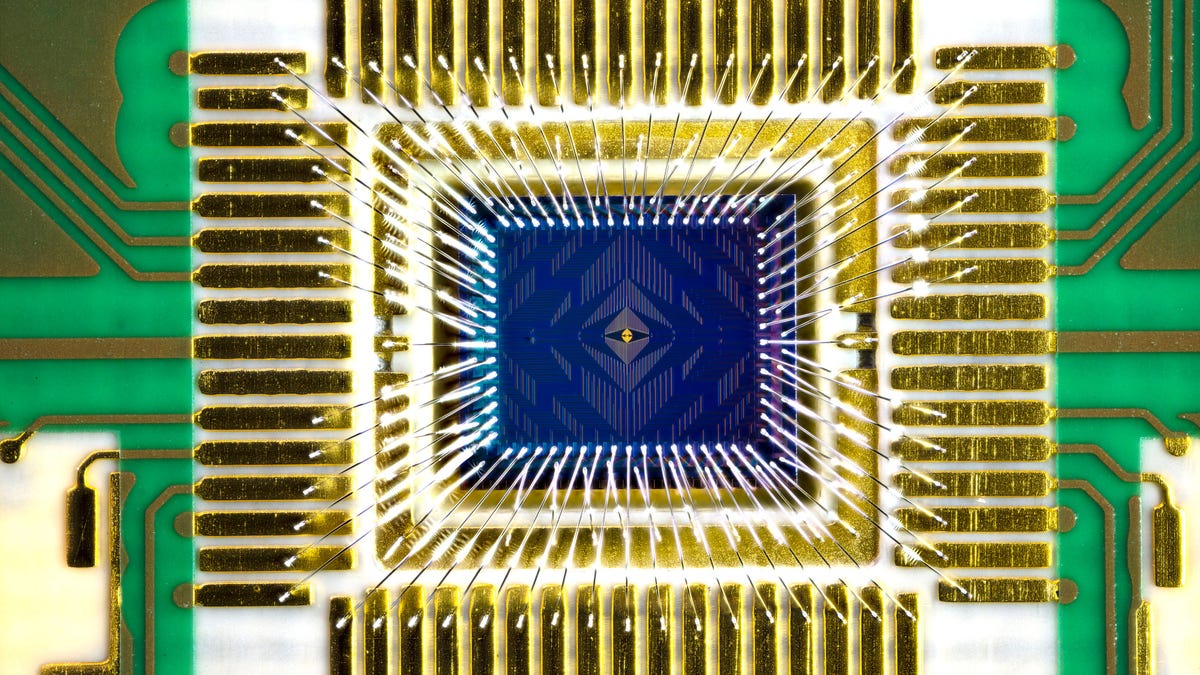
While IBM and Google race to scale superconducting qubits and Microsoft bets on topological qubits, Intel is pursuing a fundamentally different approach: silicon spin qubits. The strategy reflects Intel's core competency — semiconductor manufacturing — and a long-term bet that the path to millions of qubits runs through the same fabrication processes that produce classical computer chips.
Intel's latest silicon spin qubit device, the Tunnel Falls chip, contains 12 qubits fabricated using Intel's 300mm wafer process — the same process used to manufacture classical processors. The chip demonstrates single-qubit gate fidelity of 99.8% and two-qubit fidelity of 99.0%, competitive with superconducting qubits but achieved at room-temperature-compatible fabrication scales.
The Silicon Advantage
Silicon spin qubits encode quantum information in the spin state of individual electrons or nuclei in silicon. The approach has several potential advantages over superconducting qubits. Silicon qubits are physically much smaller — a silicon spin qubit is roughly 50 nanometres across, compared to several hundred micrometres for a superconducting transmon qubit. This means that in principle, silicon spin qubits could be packed at densities millions of times higher than superconducting qubits.
Silicon qubits also operate at temperatures compatible with existing cryogenic infrastructure (around 1 Kelvin, compared to 15 millikelvin for superconducting qubits), and their fabrication is compatible with existing CMOS processes. Intel argues that this compatibility will ultimately allow quantum processors to be manufactured at the same scale and cost as classical chips.
"The semiconductor industry has spent 70 years learning how to make silicon devices at scale with extraordinary precision. We believe that expertise is the most valuable asset in the quantum race, and silicon spin qubits are how we bring it to bear."
— Anne Matsuura, Director of Quantum Applications and Architecture, Intel Labs
The Challenges
Silicon spin qubits face significant challenges that have slowed their development relative to superconducting qubits. The most significant is qubit connectivity: silicon spin qubits can only interact with their nearest neighbours, making it difficult to implement the long-range interactions required by many quantum algorithms. Superconducting qubits can be connected with microwave resonators over distances of millimetres, providing much more flexible connectivity.
Silicon spin qubits are also more sensitive to charge noise — fluctuations in the electrostatic environment that cause qubit decoherence. Managing this noise requires extremely precise control of the silicon substrate and gate voltages, adding manufacturing complexity.
The Long-Term Roadmap
Intel's quantum roadmap targets a 1,000-qubit silicon spin qubit processor by 2028, with a path to millions of qubits by the mid-2030s. The company is also developing a cryogenic control chip — the Horse Ridge series — that can operate at the same low temperatures as the qubits, addressing the classical control bottleneck that limits the scalability of all qubit technologies.
Whether Intel's long-term bet will pay off depends on whether the density and manufacturability advantages of silicon spin qubits can overcome the current fidelity and connectivity disadvantages. The quantum hardware race remains genuinely open, and Intel's approach may yet prove to be the winning strategy at scale.